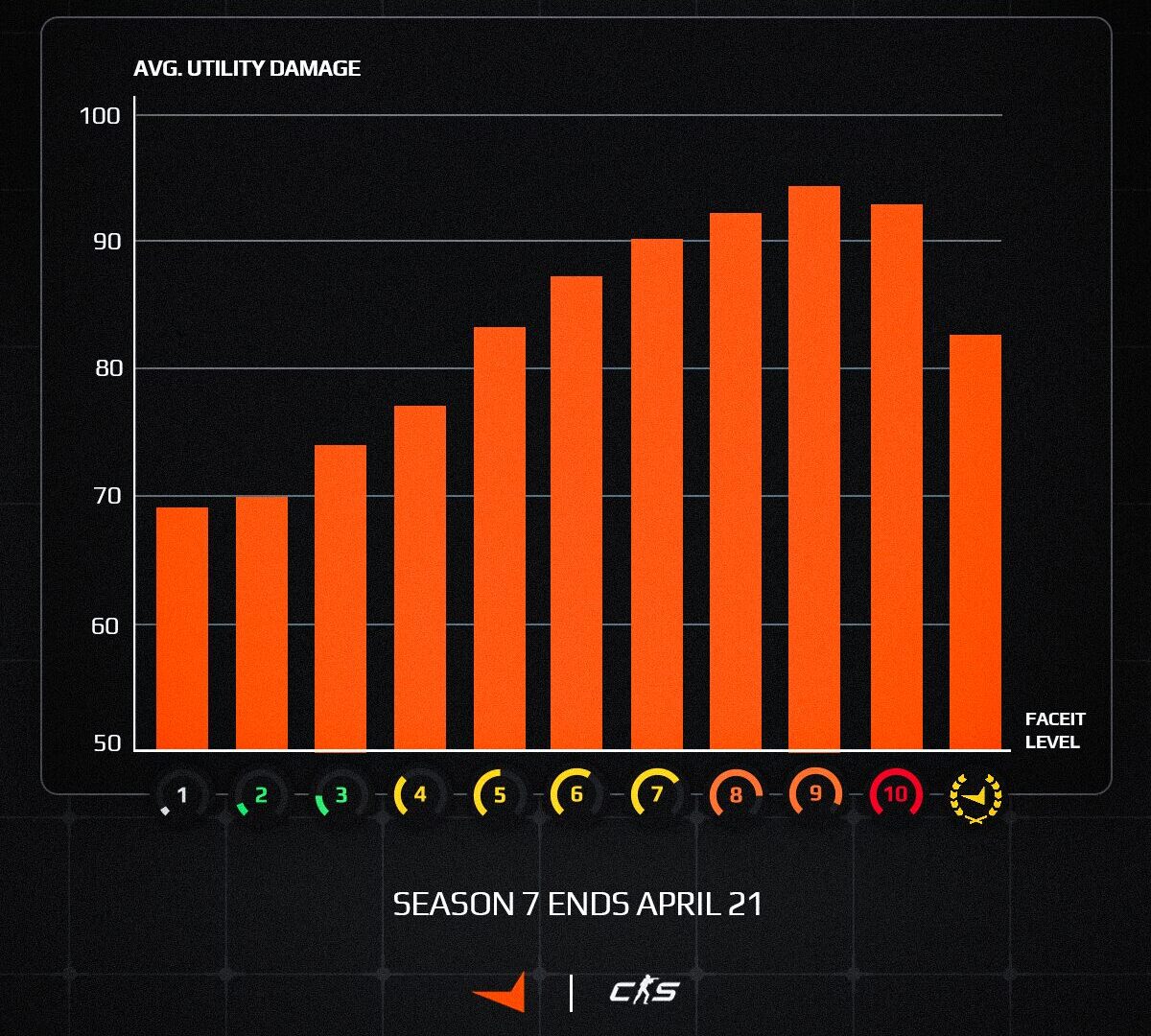
Season 7 FACEIT statistics have sparked an intriguing discussion within the community: average grenade damage consistently increases with lobby level, yet the curve displays a noticeable dip at the very top tiers. This naturally raises the question — do elite players actually rely less on utility, or is the picture distorted by role distribution and match dynamics?
What the FACEIT Data Reveals
The overall trend appears intuitive: the higher the player level, the more effective the grenade usage. In this context, utility damage serves not as a measure of mechanical skill, but as an indicator of timing awareness, positional pressure, and micro-interactions within rounds.
The growth observed across mid-level brackets is relatively straightforward to explain. More experienced players integrate grenades into round structure more efficiently. This goes beyond basic smokes or flashes and extends to systematic HE grenade usage, molotov-based area denial, and repeated retake protocols.
read more

The High-Level Paradox
The most compelling aspect of the graph is the localized decline in utility damage at peak levels. While this may initially appear paradoxical, several rational explanations exist.
First, decision-making speed in high-ELO matches is significantly higher. Engagements occur earlier, duels are more frequently resolved through direct aim, and many exchanges conclude before extended utility cycles even develop.
Second, positional efficiency increases. Players are less often forced into scenarios where grenades become the primary tool for space creation or opponent destabilization.
Role Composition Effects
A central element of the discussion involves player roles. A substantial portion of top-ranked Challenger players are AWPers, which can materially influence utility metrics.
The AWP role inherently reduces dependence on damage-oriented grenades. Snipers typically operate from established sightlines, emphasizing positional control and opening picks, whereas HE grenades are more closely associated with rifler engagements and forced exchanges.
As a result, matches with high sniper concentration may statistically exhibit lower utility damage without implying any decline in tactical sophistication.
Does Aim Replace Utility?
The notion that superior aim diminishes the need for utility is partially valid but requires nuance. At elite levels, grenades do not disappear — their functional role evolves.
Utility shifts from being a compensatory mechanism for weaker mechanics to a tool of option control. Grenades are deployed less for maximizing raw damage and more for manipulating space, tempo, and decision trees.
Consequently, reduced utility damage does not inherently imply reduced utility importance. Instead, it may reflect a fundamentally different structure of round interactions.
read more
Rising Utility Damage
Season 7 FACEIT data aligns with established Counter-Strike logic. Increasing utility damage across levels reflects improved game literacy, while the decline at the top likely stems from faster engagements, stronger positioning, and role-specific dynamics.
The utility-versus-aim debate at the highest tiers is not binary. Elite play does not diminish the value of grenades — it redefines how they shape outcomes.