
The Counter-Strike community has once again turned its attention to subtick — but this time, not through player impressions, but through a deep technical analysis. A researcher known as eugenio8a8 has published an extensive paper on Reddit, breaking down the architecture of subtick in CS2, its determinism, and its fundamental limitations.
Subtick under the microscope: what is really happening in CS2
In his work, the author explains that subtick is not simply a “better tickrate,” but a fundamentally different approach to handling player inputs. The key idea is that the system offers extremely high temporal precision for input timing, but is limited in how often the simulation itself updates.
According to the analysis, subtick:
- timestamps player inputs with very high precision
- but advances the simulation in discrete steps tied to frame updates (FPS)
- meaning multiple distinct inputs can be resolved within the same simulation update
This creates a phenomenon described as temporal aliasing — where the game effectively “sees” less than what actually happens in time.

Why 128 tick doesn’t solve the issue
One of the main conclusions of the study is that increasing tickrate (for example, to 128 tick) does not fix the core problem.
That’s because:
- the limitation is not in data transmission
- but in the simulation architecture itself, which remains frame-dependent
In other words, even with higher tickrates, the game still processes states in discrete steps rather than continuously.
Determinism and FPS: unexpected findings
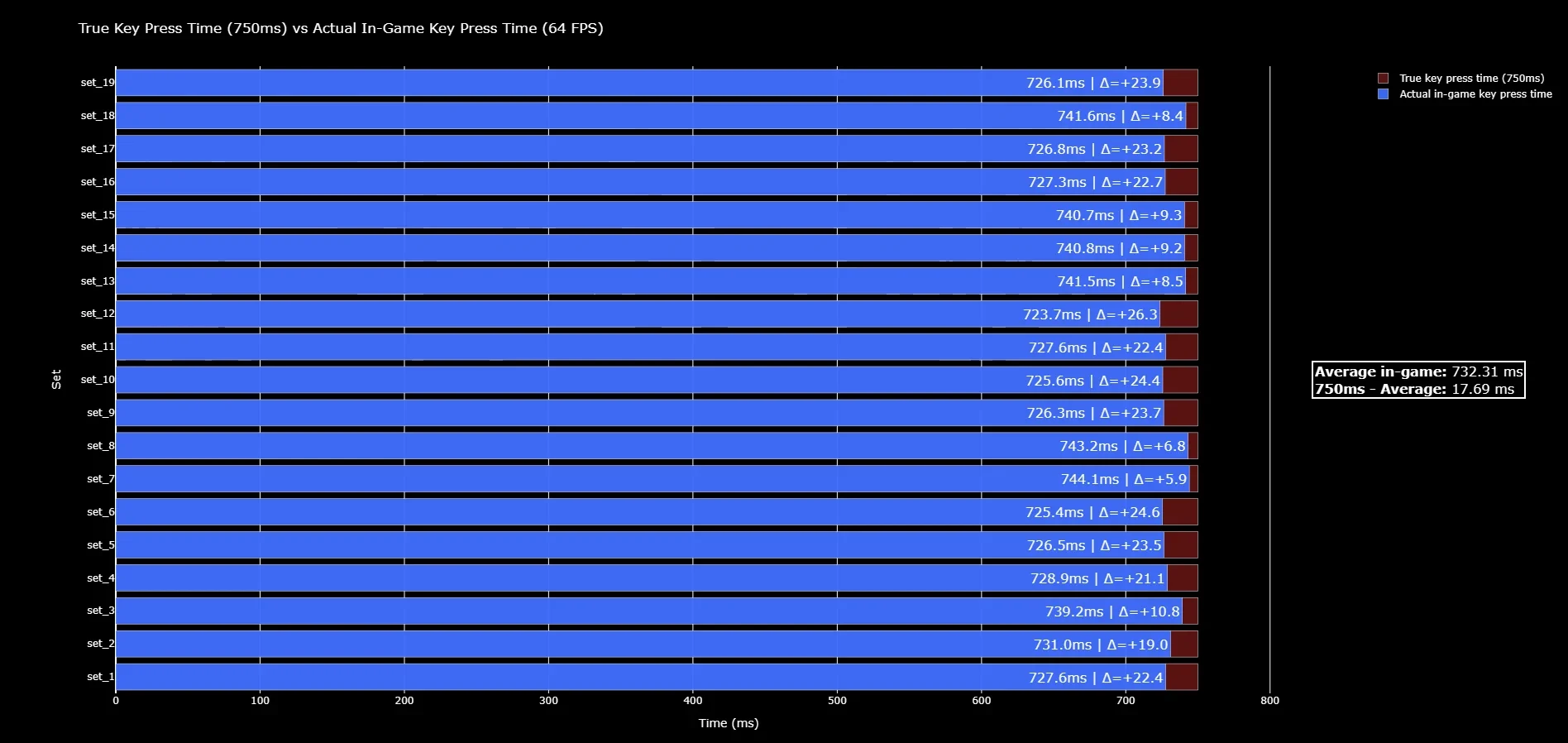
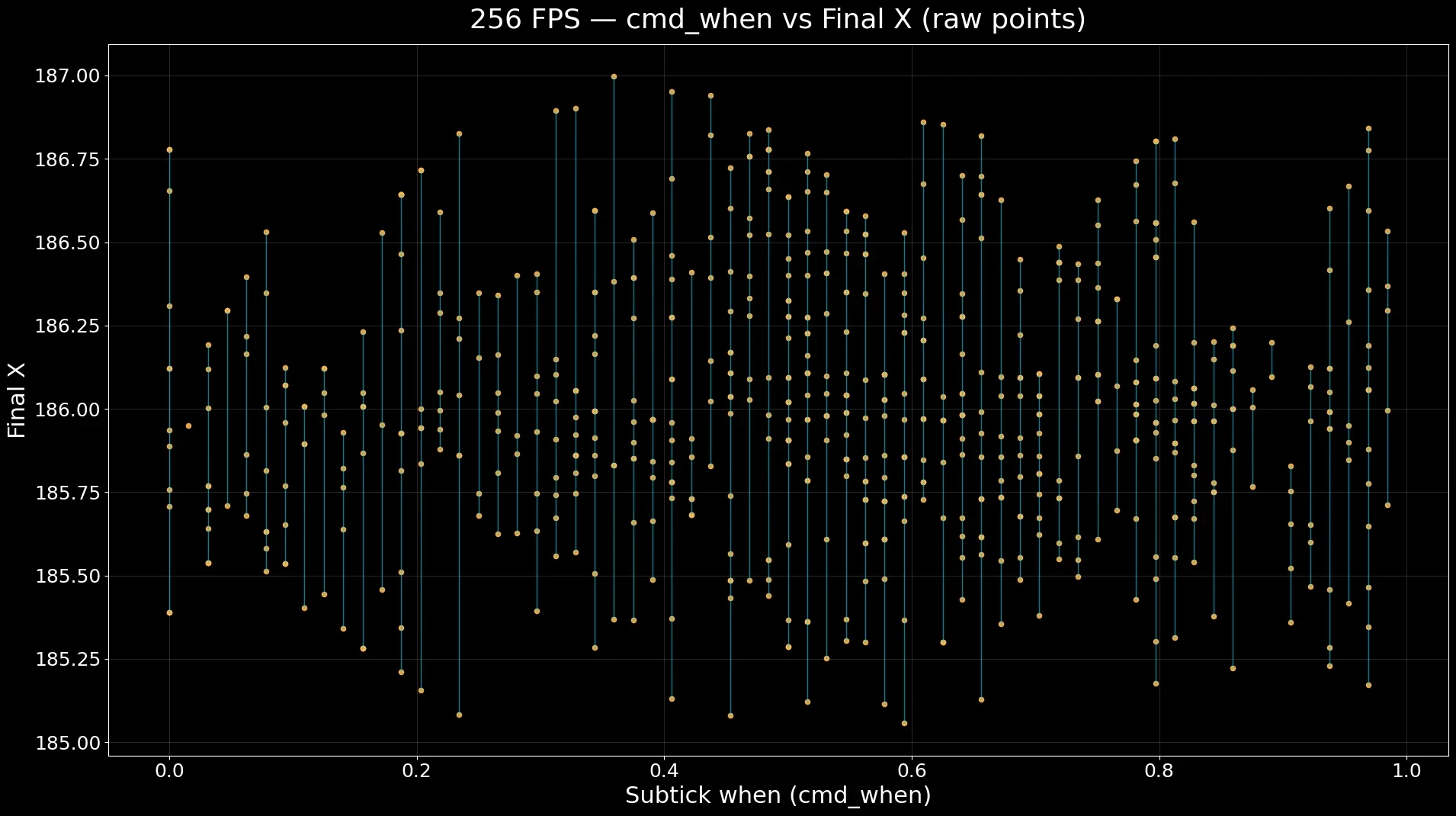
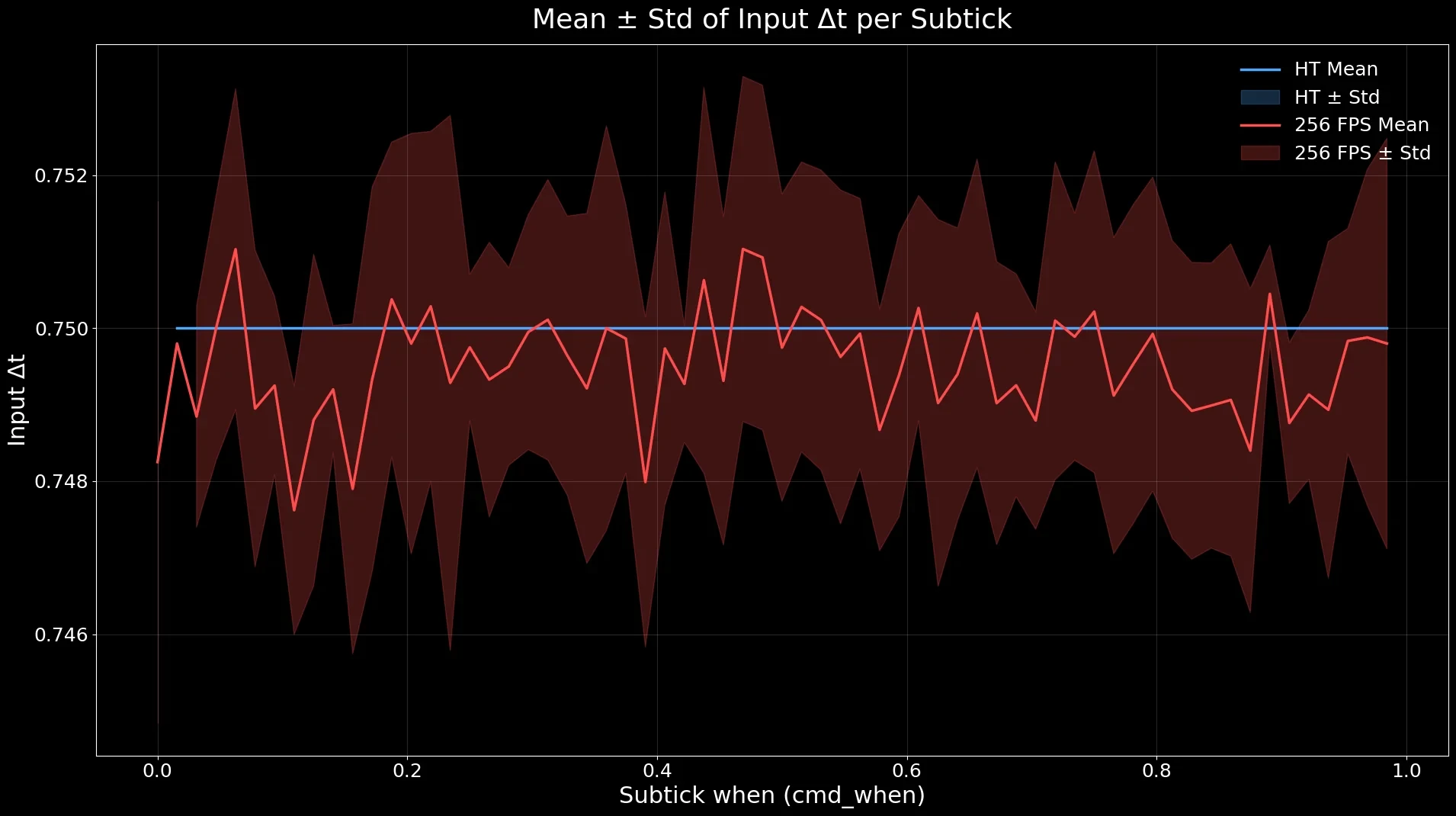
The author conducted multiple experiments using fixed-duration inputs (for example, holding forward for exactly 750 ms) and observed the following:
- at lower FPS → significantly higher variation in results
- at higher FPS → outcomes become more consistent
Even under identical conditions, results are not always identical, raising questions about true determinism. The paper suggests that subtick becomes deterministic only when:
- the simulation update rate (FPS) exceeds the timestamp precision
Core conclusion: the issue runs deeper
The key takeaway from the research is:
Subtick improves input ordering and precision, but it does not change the fundamental nature of simulation — it remains step-based.
This means:
- CS2 can measure time more precisely than it can resolve it
- the real solution would require decoupling simulation from frame updates
In the long term, this could lead to asynchronous or sub-step simulation, where game state updates independently of FPS.
Community reaction and author’s stance
In follow-up discussions on X, the author emphasized that comparing subtick directly to traditional tickrate systems is misleading:
It’s like comparing oranges to apples… but in my opinion, subtick is a superior system.
The discussion quickly gained traction, as subtick remains one of the most debated aspects of CS2.

What this means for players
For everyday players, this research helps explain familiar in-game sensations:
- inconsistent shooting feel
- subtle input irregularities
- gameplay differences depending on FPS
While subtick does improve input precision, it also introduces new limitations that were less noticeable before.