For years, reaching a Counter-Strike Major offered organizations something much more valuable than tournament prize money. Qualification gave every participating team access to the game’s enormous cosmetic economy through official team and player stickers. A team could leave without winning much prize money yet receive enough sticker revenue to fund its roster for several months. For smaller organizations, a single successful qualification could transform their financial position.
That financial safety net may now be weakening. Following the IEM Cologne Major, organizations reportedly began raising concerns about the returns generated by Valve’s redesigned Major Shop. Preliminary figures circulating within the scene suggest that one Stage 1 team received approximately $60,000 for the organization, or around $120,000 when the players’ share was included. A Stage 2 organization reportedly received slightly more than $120,000 in total.
These figures have not been independently audited, and the Cologne sales period may not yet be complete. However, the early comparison is alarming. Comparable capsule participation at the Budapest Major reportedly generated close to $600,000 for some organizations. The difference may represent a fundamental change in how money moves through professional Counter-Strike.
How Major stickers became Counter-Strike’s unofficial revenue-sharing system
Valve introduced team stickers at the EMS One Katowice Major in 2014. Player autograph stickers followed at ESL One Cologne in 2015. Since then, stickers have developed from simple tournament memorabilia into one of the most important financial mechanisms in Counter-Strike esports.
Traditionally, players purchased capsules containing a randomized sticker from a group of teams or players. Stickers were offered in several finishes, with rarer versions such as holographic, foil and gold stickers encouraging repeated capsule openings. Valve shared 50 percent of the proceeds associated with Major items with participating teams and players.

That arrangement gave Counter-Strike something most esports titles lacked: a direct connection between the game’s cosmetic economy and its professional competitors. Organizations did not have to negotiate a permanent league partnership or depend entirely on tournament organizers for revenue sharing. They needed to build a competitive roster, qualify for the Major and submit an eligible logo. Players received the same opportunity through autograph stickers.
The system was imperfect and opaque. Valve did not generally publish detailed capsule sales, payment calculations or a complete breakdown of how much each organization received. Contractual arrangements also determined how sticker money was divided between players and their employers.
Nevertheless, the system injected substantial amounts of money into the ecosystem. More importantly, it distributed money beyond the handful of teams capable of winning tournaments. The prize for finishing near the bottom of a Major was relatively small, but sticker sales could still make qualification extremely profitable.
Why the old capsule model generated so much money
The previous system benefited from two powerful purchasing behaviours. Capsules were inexpensive enough to encourage repeated purchases, while their randomized format meant customers could not simply choose the exact sticker they wanted. Someone pursuing a popular autograph or rare holographic team logo might receive many unwanted stickers before obtaining the desired result.
The scale of the resulting revenue was extraordinary. Valve said in 2022 that more than $70 million had been distributed to participating teams and players through Major item sales during the preceding 12 months.
Individual disclosures also demonstrated how significant those payments could become. In discussions about professional finances, STYKO has described Major sticker money as a potentially career-changing source of income, with players from successful Major cycles receiving six-figure payouts.
The exact amount varied according to the Major, capsule group, length of the sale, sticker design and contractual split. However, reported player earnings frequently ranged from around $100,000 to several hundred thousand dollars from one Major. For many competitors, that could exceed several years of tournament prize money.
What Valve changed before the Cologne Major
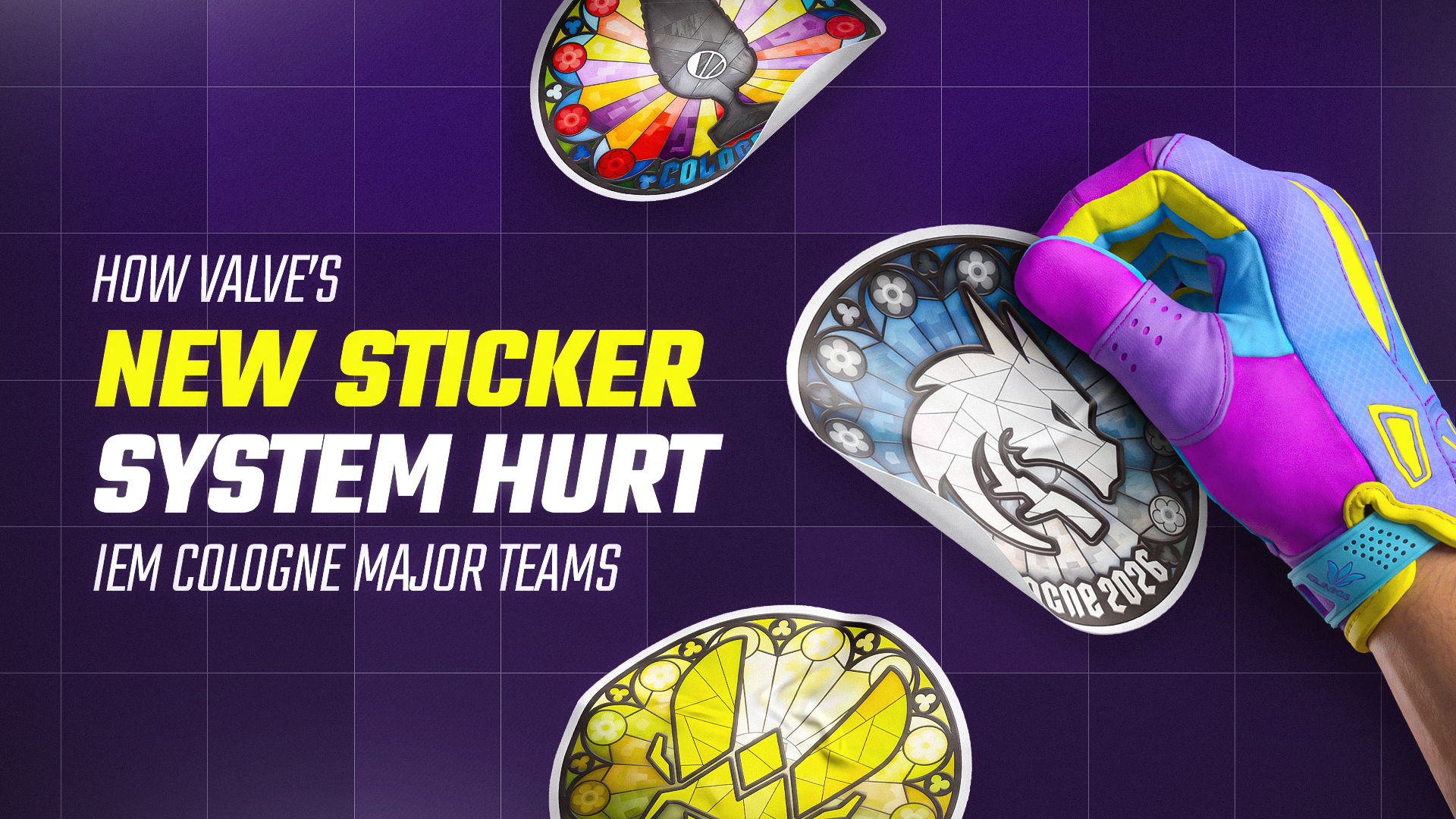
On May 21, 2026, Valve introduced a major redesign of the Major Shop for IEM Cologne. Instead of relying primarily on randomized capsules, players could purchase tokens and redeem them for specific stickers. A buyer who wanted one particular player autograph or team logo no longer needed to open capsules and hope for the correct result.
Sticker prices were determined by relative demand. When one sticker was purchased disproportionately more often, its token price increased while the prices of other stickers decreased. The consequences became visible almost immediately. During the Cologne Major, the combined cost of purchasing one of each of the 100 most expensive event stickers reportedly reached approximately $19,447. The most expensive individual sticker was valued at more than $1,500.

Valve confirmed that 50 percent of total Major Shop and Major Pass revenue would continue to be shared as royalties with the tournament organizer, teams and players. The percentage directed towards the esports ecosystem therefore remained significant. The concern was whether the redesigned shop would generate the same level of total spending as capsules.
The distribution model also changed. Rather than tying each organization’s income directly to purchases of its capsule, Major Shop revenue entered a shared pool. The organizer received a portion, while teams and players were allocated percentages based on factors including Valve Regional Standings and Major placement. Lower-ranked teams therefore received a smaller fixed share than the strongest performers.
What the early Cologne figures suggest
The reported Cologne numbers indicate a significant decline from the previous Major economy.
According to figures circulating after the event:
- A team eliminated during Stage 1 reportedly received around $60,000 for the organization, or approximately $120,000 including the players’ share.
- A Stage 2 participant reportedly earned slightly more than $120,000.
- Comparable Budapest Major capsules were said to have generated close to $600,000 for some participants.
- Approximately one month after the Cologne final, some organizations were reportedly earning only around $100 per day from continuing sales.
These should be treated as preliminary reports rather than confirmed final accounts. Different teams may also receive different amounts depending on their ranking, placement and Valve’s distribution formula.
Even with those qualifications, a reduction of this scale would be difficult to dismiss. An organization expecting several hundred thousand dollars from Major qualification may have committed to player buyouts, salary increases or operational expansion months before the event. Receiving a fraction of the projected amount does not merely reduce profit. It can create an immediate budget deficit.
Community reactions
The reported decline in Major sticker revenue quickly drew reactions from players, coaches, casters and other figures across the Counter-Strike scene. While most agreed that the new system had damaged the ecosystem, there was less agreement over Valve’s responsibility to guarantee teams a particular level of income.
Russel “Twistzz” Van Dulken argued that sticker revenue had already been declining, but that the Cologne system had made the situation considerably worse:
“Stickers have unfortunately been on a downward trend for a while with the exception of the Champions capsule really boosting revenue for the winners. The gap between the different capsules were growing far apart over the years regardless, but this new system has hurt the eco-system entirely.
“This article is very insightful and would be an important read for those working at valve and over-seeing CS.”
Twistzz
SINNERS in-game leader Sebastian “beastik” Daňo said his own calculations showed that even winning the Major produced relatively little sticker income under the redesigned system:
“I was wondering why no one is complaining how bad it was this major money-wise. I did my counting based on what we made up until now and winning major is very, very low when it comes to sticker money that investments into CS are way harder now.”
beastik
Alexander “kakafu” Szymanczyk, who has worked as a coach and analyst across several Counter-Strike teams, warned that Major qualification had previously justified the time and sacrifices required to remain in the game:
“Making the major meant that everything paid off, the sacrifices and the time that is invested in CS. Now with this I don’t know where the future is headed but I really hope valve finds a way. Even 1.6 couldn’t survive on just ‘passion’ and needed the community or the publisher.”
kakafu
Caster James Bardolph similarly argued that damage to the lower levels of the ecosystem should be treated as a threat to professional Counter-Strike as a whole:
“Any threat to the pyramid starting from grassroots leading to top flight CS should be looked at seriously; there are plenty of examples around of games with broken systems and all the problems it causes.”
Bardolph
Wilton “zews” Prado offered a more detailed interpretation, arguing that the controversy involved several separate changes rather than only a decline in the final revenue figure:
“Counter-Strike’s economy is being regulated and rebuilt while everyone is still living inside it. Most reactions to this are collapsing three separate changes into one number. Valve changed how fans buy stickers, how players and orgs split the money, and how Major revenue is distributed. Some parts may be overdue. Others clearly failed.”
zews
Anders Blume took a more sceptical position on the assumption that Valve must restore the previous level of team revenue. He distinguished between the fact that organizations were earning less and the prediction that this would necessarily damage the scene:

“There is a really interesting jump that happens in logic from ‘teams are making less’ to ‘if this doesn’t change something bad will happen. One is a statement of fact. The other carries an implication about what valve’s role and responsibilities are to the teams or the space as a whole… I think it’s super interesting to try and interrogate those implications in great detail, I’m not always sure it’s as easy an argument to make as some people think. Give me your best argument why valve should improve the amount teams make, genuinely asking.”
Anders
Together, the reactions illustrate the central debate created by the update. Players, coaches and casters broadly recognize that organizations are receiving less money, but the wider question is whether Valve should restore the old model, modify the current distribution system or allow teams to adjust to a less dependable source of Major income.
The Impact of the Update:
1. The transfer market could become more cautious
One of the first consequences is likely to appear in the player-transfer market. Organizations have previously been willing to pay significant transfer fees for rosters that offered a realistic path to the Major. The logic was straightforward. Even if the team did not become a championship contender, Major qualification could generate enough sticker revenue to justify the investment.
If sticker returns are no longer predictable, that calculation changes. A transfer fee cannot be justified through expected Major income when the possible payout ranges from several hundred thousand dollars to only a small percentage of that amount. Organizations may become less willing to purchase complete rosters, pay buyouts for emerging talent or provide long contracts to teams outside the elite.
The market could become increasingly divided. Major brands with strong sponsorship portfolios or wealthy ownership may continue spending. Smaller organizations will be forced to pursue free agents, short-term contracts and inexpensive regional lineups. That would make it harder for a promising tier-two team to stay together long enough to develop.
2. Smaller organizations carry the greatest risk
Sticker revenue has always mattered to smaller teams more than it mattered to globally established organizations. A leading organization may have commercial partnerships, merchandise revenue, content operations and investment capital. Major stickers are highly valuable, but they are only one part of a larger business. For a smaller organization, sticker money can represent the majority of its annual Counter-Strike income.
The effects extend beyond the five players on the server. Major revenue can fund coaches, analysts, psychologists, managers, content creators and social-media staff. It can cover travel to international events and allow players to practise full-time rather than taking additional employment. Without that income, smaller teams may have to reduce salaries, release support staff or sell their best players immediately after a successful run.
The situation is particularly dangerous for teams from Asia, Oceania, South America and other regions with fewer high-paying tournaments. For some of these organizations, the Major is not simply the most prestigious event of the season. It is the only event capable of generating transformative revenue. A weaker sticker system could therefore deepen the gap between Europe’s established infrastructure and developing regional scenes.
3. Players could also lose financial security
Players are not protected from the decline. Autograph stickers have historically provided competitors with a rare form of income directly connected to their personal brand. A popular player could receive a meaningful payout independent of salary, prize money or organizational performance.
That money is especially important because professional careers can be short. A player may spend years attempting to qualify for a Major and receive only one autograph sticker during an entire career. Lower sales reduce the reward for reaching that milestone. They may also create new disputes between players and organizations. Sticker percentages are frequently addressed in player contracts, but agreements built around expected historical payouts may become less attractive when the total revenue pool contracts.
Organizations facing losses could attempt to negotiate a larger share. Players may resist because the sticker represents their name and signature. The economic pressure created by reduced sales could therefore make contract negotiations more contentious.
4. Tournament organizers could be affected as well
The new system does not only distribute royalties to teams and players. Valve has stated that the tournament organizer also receives a share of Major Shop and Major Pass revenue. A weaker shop therefore threatens the economics of hosting a Major. Major tournaments require large venues, extensive production teams, practice facilities, international travel coordination and weeks of competition. The prestige is enormous, but the costs are equally significant.
If organizer royalties decline, fewer companies may be willing to accept the financial risk of hosting future Majors without additional guarantees from Valve. That would be an ironic result. A system designed to make Major items more accessible in restricted regions could ultimately reduce the resources available to produce the tournament itself.
Counter-Strike cannot afford to treat sticker money as an afterthought
The Major sticker economy has grown into one of Counter-Strike’s most important institutions, even though it was never formally presented that way. It finances organizations, rewards players, supports tournament organizers and gives smaller teams a reason to invest in long-term competition. In many cases, it provides more practical value than the official prize pool.
That dependence also exposes the ecosystem’s vulnerability. Valve can alter the economics of professional Counter-Strike through a single game update. Organizations do not receive guaranteed franchise payments, long-term media-rights distributions or fixed Major participation fees. Their returns depend heavily on a digital shop whose prices, availability periods and revenue calculations are controlled by one company.
The Cologne Major may prove to be an experiment rather than a permanent decline. A late discount, pricing adjustment or stronger sales period could still improve the final totals. But if the preliminary reports are accurate and Cologne revenues remain far below Budapest levels, teams will be forced to reconsider how they operate. Transfer spending will fall, tier-two investment will become riskier and Major qualification will lose part of the financial reward that has sustained Counter-Strike’s open ecosystem.
Valve’s new system may make it easier to buy the exact sticker a customer wants. The larger question is whether, in solving that problem, it has weakened the economic structure supporting the people whose names and logos make those stickers valuable.