
A small in scope but consequential Counter-Strike 2 update delivered a fix for a critical bug that had the potential to compromise competitive integrity. The issue involved an exploit enabling players to locally “freeze” the game simulation and extract unintended informational advantages.
What the Update Addressed
Within the latest patch, the developers introduced several technical corrections:
[ MISC ]
- Resolved a performance issue primarily affecting Windows 10 systems with newer Intel CPUs
- Fixed an error related to Delete Item in the inventory
- Eliminated visual artifacts when using iron sights on AMD GPUs
- Expanded the list of console variables available to addons
[ MAPS ]
- Overpass – Fixed Party balloons
Despite the routine appearance of the changelog, community attention quickly shifted toward a less explicit but far more impactful correction.

The “Time-Stop” Bug: Nature of the Problem
Players recently identified an exploit that interfered with the client’s fundamental simulation logic. By binding a console command, users could trigger a local time-stop effect:
- For the player, the game appeared to freeze
- Model positions and in-game events became static
- Limited movement inputs remained possible
- The client subsequently reverted to the original state
The core issue was informational rather than visual. The exploit allowed players to observe opponent positions without assuming genuine risk or time investment — a direct violation of the principles underpinning competitive FPS gameplay.
Why This Was Critical for Matchmaking and Tournaments
Bugs of this class extend beyond technical inconvenience. They represent systemic threats to competitive balance. In an environment where milliseconds and positional information determine outcomes, any mechanism that bypasses intended game constraints becomes critical.
The time-stop exploit:
- Reduced the inherent risks of gathering information
- Bypassed standard positional-check dynamics
- Introduced asymmetrical advantages
Under widespread abuse scenarios, such behavior could materially distort match results.
A One-Line Code Fix
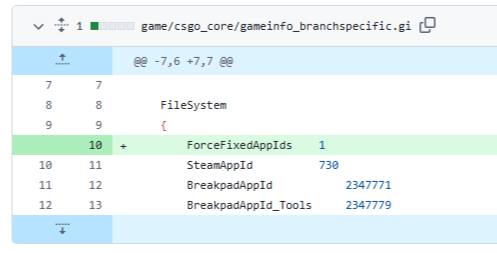
According to observations from technical analysts and datamining communities, neutralizing the exploit required only a minimal adjustment within the game’s configuration — effectively a single line of code in the relevant system logic.
Such instances are not uncommon in software development. Bugs with complex gameplay implications may originate from seemingly trivial state-handling oversights or parameter validation gaps.
A Familiar Pattern
Comparable mechanics have previously surfaced in earlier Counter-Strike iterations. Valve historically responded quickly to similar vulnerabilities, yet transitions to updated engines and architectural frameworks can reintroduce legacy issues in modified forms.
This incident exemplifies a classic regression bug scenario, where previously resolved problems reappear following large-scale codebase transformations.

Eliminating the Time-Stop Exploit
Although modest in size, the update carries disproportionate importance. Removing the time-stop exploit directly reinforces gameplay integrity and competitive reliability within CS2.
In a discipline where mechanical consistency and simulation predictability are foundational, even a single line of code can play a decisive role in preserving fair play.