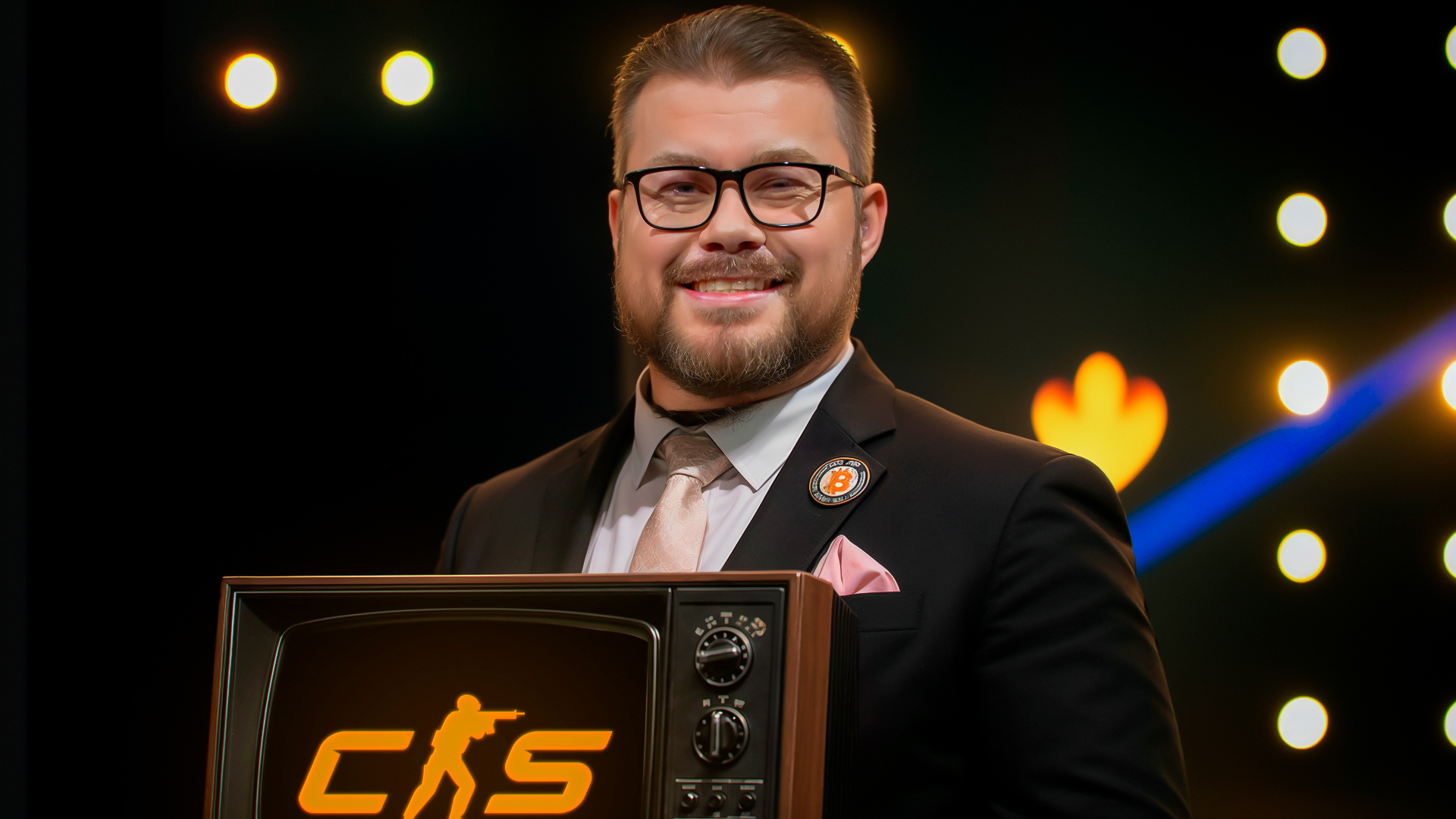

James Banks and veteran Counter-Strike creator 3kliksphilip sat down to reflect on the game that shaped both of their careers. Although they followed completely different paths—one becoming one of esports’ most recognizable interviewers and stage hosts, the other building one of Counter-Strike’s most influential YouTube channels—their stories began with the same passion for the game. From childhood memories and the early days of Counter-Strike to mapping, frag movies, esports, and content creation, both share how a single game ended up defining their lives.
How Do You Come Up With Good Interview Questions?
I think the best way to do it is just be naturally interested in it. It would be very hard for me to go and do a League of Legends interview because I don’t follow the game. I only watch Worlds because, from the production side, it’s amazing. It gives me a lot of ideas and inspiration. But if you gave me a League of Legends player, it wouldn’t be passionate for me. Because I love Counter-Strike and follow it in depth, it’s much easier to come up with questions.
Look at this conversation right now. I have no prep, no time to look at anything. But if you can make a conversation flow naturally, and you both have a common enjoyment—which is Counter-Strike—then it can just work. You don’t always need a massive list of prepared questions. Sometimes the best interviews come from genuine curiosity and knowing enough about the subject to let the conversation develop naturally. (Editors note, this “interview” was just James Banks & 3kliksphilip having a chat, that turned into two separate very interesting interviews as they both discussed the game they love)
How Did You First Discover Counter-Strike?
I found Counter-Strike when I was 12 years old. My friends at school were playing it, and before that I wasn’t really gaming in the PC sense. I had a PlayStation, but most of my life revolved around football, basketball where I was on school teams, as well as taekwondo, and just generally being outside.
Then I met a group of friends who were heavily into Counter-Strike and RuneScape. At first it wasn’t really my thing because I wasn’t spending much time on computers, but eventually it completely took over. The more time I spent around them, the more interested I became in Counter-Strike. Before long I was completely addicted to the game and spending every opportunity I had, I would be playing it.
Did Your Childhood Friend Influence Your Gaming Journey?
Absolutely. My best friend had a huge influence on me growing up. His parents were divorced, and later mine divorced as well. We ended up arranging our schedules so that we spent weekends together at his dad’s place. His dad owned a business and had two computers there, which was incredibly rare for us at the time, this is 1998/1999. We would spend entire weekends playing games together. We’d go to places like Blockbuster, rent games, install them, and spend hours figuring them out. He was naturally talented at every game we touched. To this day, I genuinely believe that if he had chosen that path, he could have become a professional player. He understood games instinctively and was far better than I was. Ironically, he ended up becoming a police officer, but he was one of the biggest reasons I fell in love with gaming in the first place.
What Role Did Half-Life Play in Your Gaming Journey?
Half-Life was absolutely massive for me. We somehow ended up with two copies that worked, which meant we could play together. We went through the campaign, taking turns and helping each other solve sections, and then we moved into Half-Life Deathmatch. That was one of my earliest experiences with online gaming. Looking back now, it’s probably one of the moments that truly started my obsession with multiplayer games. Half-Life wasn’t just another game we played. It opened the door to an entirely different world of gaming that eventually led me towards Counter-Strike.
What Was It Like Growing Up Without Your Own Gaming PC?
For a long time I didn’t really have one. At home we had an old Windows 95 machine that was mostly used for basic family stuff. It wasn’t a gaming PC by any stretch of the imagination. A lot of my gaming experiences happened at my friend’s house because that’s where the better computers were. When I was at home, I’d spend time messing around in Paint or doing whatever I could on the machine we had.
Looking back, I actually think not having constant access to games made me appreciate them more. Every chance I got to play felt special, and when I finally got access to a proper PC later on, then I completely threw myself into gaming.
Did You Ever Want to Become a Professional Counter-Strike Player?
In Counter-Strike 1.6 you could say I was a semi-professional player and I definitely dreamed of making it as a real professional, going to the biggest events and travelling all the time or being featured in the frag movies. Before Counter-Strike, gaming was mostly just a hobby and something I enjoyed with friends. But once I started taking Counter-Strike seriously, that changed.
I began following professional teams, watching tournaments, downloading demos and frag movies, and learning more about the competitive scene. That’s when I started imagining myself becoming a professional player one day. For the first time, gaming felt like something that could be more than just entertainment. I am pleased to say I did play high level in the for Counter-Strike during the 1.6 days, regularly on the UK LAN circuit and playing qualifiers for ESWC and WCG but the only touch of being a real professional player was when I joined Team Infused as a Virtua Fighter 5 player and even walked away with a WCG UK Silver medal. Playing on stage, being commentated and losing in the final.
How Did You Discover Competitive Counter-Strike?
The turning point came after my parents split up and I was already gaming a lot with my friend I mentioned earlier. My dad bought a really good computer, and whenever I stayed with him I could finally play Counter-Strike properly at 100 FPS. At the time that felt incredible. I used to go play all my official Enemydown, SGL and CSGN matches from his house to make sure I was at my best. Around the same period, we started going to a local cyber café in Reading called Quarks. It wasn’t just a single location either. They had centres in Reading, London, Manchester, and Scotland.
Every now and then we’d play against teams from the other locations. That was my first real exposure to competition. It wasn’t professional Counter-Strike, but it felt serious to us. The moment I experienced that competitive environment, I was hooked. I immediately wanted more of it and knew I wanted to be involved in Counter-Strike at a higher level somehow.
How Good Were You as a Player Back Then?
This is not long after starting, I think 2003. Mechanically, I was pretty good. My aim was definitely my strongest quality. The problem was that I had absolutely no understanding of teamwork. Everything we did was five friends from school running around together. We didn’t understand utility. We didn’t understand tactics. We didn’t understand proper positioning or team play.
It wasn’t until I started watching professional matches and downloading demos that I realized how much deeper Counter-Strike actually was. That’s when I began understanding how the game was supposed to be played. Then coming into 2005 I started playing with much better people who were not my real life friends, that is where I was able to learn so much.
How Important Were Frag Movies in Early Counter-Strike?
They were everything. Today you can open social media and watch highlights instantly. Back then that didn’t exist. If you wanted to see incredible plays, you downloaded frag movies, gotfrag and other websites had them all listed. I spent countless hours watching them. They had insane editing, rock music, unbelievable highlights, and they made professional players look superhuman. As a young player, you genuinely believed these guys were hitting impossible shots every round. Frag movies were a huge part of building the legends of early Counter-Strike and a huge part of why I became obsessed with the game.
Which Frag Movies Left the Biggest Impression on You?
There were a lot of great frag movies during that era, but the one that always stands out for me is Team Complexity: Redemption. What made it different wasn’t just the highlights. Most frag movies focused entirely on the in-game moments, but Redemption went beyond that. It showed the players at events, the atmosphere around tournaments, their personalities, and what life was actually like inside a professional team. For me, that was fascinating because it made professional Counter-Strike feel real. It wasn’t just five players hitting incredible shots anymore. These were actual people traveling, competing, dealing with pressure, and chasing championships.
I still remember Jason Lake running around, kicking chairs, getting emotional, hyping up the team and bringing this huge amount of energy. It felt larger than life and helped create this image of Complexity as something special. At the time, the production quality was unbelievable. Looking back now, it was one of the pieces of content that made me fall even deeper in love with professional Counter-Strike.
Did You Ever Play Counter-Strike: Source Competitively?
Not really. When Source came out, I tried it because everyone was curious about it. It was the new Counter-Strike and naturally people wanted to see what Valve had created. But pretty quickly I realized I was a 1.6 purist. By that stage I was already heavily invested in the competitive side of 1.6. I followed the teams, watched tournaments, downloaded demos, and spent most of my time consuming content related to that version of the game. Source never really captured me in the same way. I understood why some people loved it, but for me Counter-Strike was 1.6 and that was where my attention stayed.
What Was It Like Meeting Your Idol?
It was surreal. When you’re young, these people don’t feel real. You watch them through demos, frag movies, screenshots, and tournament coverage. They almost become mythical figures. Meeting someone like fRoD was incredible because he was still actively competing when I got the chance to interact with him. Then there was Jason Lake, who felt even bigger than life itself.
The funny thing is that Jason hasn’t really changed. Even today he still walks into a room with the same energy, the same passion, and the same larger-than-life personality.
One of the strangest things about my career is how many full-circle moments I’ve experienced. I went from being a kid watching these people online to interviewing them, working events with them, and eventually introducing some of them on stage in front of thousands of fans. That’s not something I ever imagined would happen when I was younger.
What Made SK Gaming So Special To You?
SK Gaming were everything to me in 2003. At the time they felt unbeatable. It seemed like every major tournament ended with SK lifting the trophy. They had players like HeatoN, Potti and SpawN, who became heroes for an entire generation of Counter-Strike fans. These were the people everyone wanted to emulate.
What made them special wasn’t just the results. They had personalities. They had star power. They carried themselves like champions. Years later, when I eventually met HeatoN and SpawN in person, it became one of those moments where reality catches up with your childhood memories.
I had spent years watching these players dominate Counter-Strike, and suddenly I was working in the same industry as them. That’s one of those experiences you never really forget. Now I am lucky enough to call all three of these players friends, who I can just pick up the phone and message whenever I want. 13 year old me would NEVER believed that it was possible.
How Did You Realize You Weren’t Going to Become a Professional Player?
At some point you have to be honest with yourself. I loved competing and I loved Counter-Strike, but eventually I realized there were players who were simply better than me. At 17 I had entered college, I stopped trying to go professional in Counter-Strike, I saw that most UK players were not making it despite being some of the best in our country.
Some were more talented mechanically. Some were more disciplined. Some were willing to dedicate their entire lives to becoming professionals. I think accepting that was important because it allowed me to look for another way to stay involved in the scene. I went professional in another game, I focused on journalism, I eventually went to work for ZOWIE GEAR and then started doing interviews. Counter-Strike was still something I wanted to be part of. I just had to find a different path.
How Did You Transition Into Journalism?
When I realized I wasn’t going to become anything but a semi professional player in Counter-Strike, journalism became the obvious first answer. The funny thing is that what we called journalism back then was completely different from what people imagine today. There wasn’t much money in esports media. There weren’t major editorial teams, large websites, or even many full-time opportunities.
We were being paid in mousepads because that was honestly closer to reality than people might think. I spent time updating scores, posting news articles, helping cover events, and basically doing whatever needed to be done. It wasn’t glamorous work and nobody was getting rich from it, but it allowed me to stay connected to the game I loved, closer to the top players at that time as well. Looking back now, I’m grateful for that period because it taught me how the industry worked from the ground up.

What Was Esports Like in the Early 2000s?
It was chaos compared to today. There were no giant organizations with dozens of employees. Teams didn’t have analysts, psychologists, performance coaches, content departments, or support staffs. Players were figuring things out themselves. The industry itself was still trying to understand what esports could become. Nobody really knew how big it would get. At the same time, there was something exciting about that uncertainty.
Everyone felt like they were building something together. Players, tournament organizers, journalists, and fans were all helping create an industry that didn’t really exist yet. That’s part of what made that era so memorable. Sadly there were bad people, taking advantage of young players and many horror stories of lies and fake promises but that can even happen today.
What Is the Biggest Difference Between the Old Counter-Strike Scene and Today’s Scene?
Professionalism. That’s the biggest difference by far. Today players have practice facilities, analysts, coaches, managers, sports psychologists, nutrition plans, bootcamps, and some of the best equipment imaginable. Back then teams would often arrive at an event and sit down at computers they’d never used before. Sometimes tournaments were best-of-one. Sometimes maps were random. Sometimes you didn’t even get vetoes.
The entire competitive environment was far less predictable. When people compare dominant teams from different eras, I think that’s something they often forget. What SK Gaming achieved in their era was extraordinary because the conditions were much more chaotic. In some ways, staying consistent back then may actually have been harder than it is today.
What Was Esports Like Financially Back Then?
It was completely different from what people see today. When SK Gaming started paying salaries around 2003, it was a huge deal because very few teams were doing anything like that. Most players weren’t earning a living from Counter-Strike. For many teams, having travel and accommodation covered was already considered a success.
Prize pools existed, but they were nowhere near modern standards. You’d see tournaments with $10,000 first-place prizes, then eventually $25,000 or even $50,000 as the scene grew. Sometimes these prizes were also not paid out or stollen by the organisation before it gets to the players. At the time those numbers felt massive, but compared to modern Counter-Strike it’s a different universe entirely. The reality is that most people stayed in esports because they loved it, not because there was money in it. I like to think it was more for the bragging rights of being the best in the world, region or country, being the champion.
Was Splitting the Community Between 1.6 and Source a Mistake?
I think it was one of the biggest lessons Valve ever learned. In the UK especially, Source exploded. Around seventy to eighty percent of the British community moved over almost immediately. The Source scene became incredibly strong, while 1.6 started shrinking locally. I still attended all the 1.6 tournaments because that’s where my interests were, but if you looked at events like I-Series, Source often felt like the bigger game.
The problem was that Counter-Strike wasn’t large enough to support two completely separate competitive ecosystems. You effectively divided the player base, the tournament scene, and the audience. Looking back, I think both versions suffered because of that split.
What Did You Think About Condition Zero?
I wasn’t a fan. Visually it looked a little better, but I didn’t like many of the changes. The grenades felt different. The shooting felt different. Even the sounds felt wrong to me. At the time I was very much a purist. I wanted Counter-Strike to remain Counter-Strike, and Condition Zero felt like it was changing things that didn’t need to be changed. For me, it never captured what made 1.6 special.
Do You Remember Any Strange Stories From The Condition Zero Era?
One of the stories that always stuck with me involved Neo and TaZ. They qualified for a tournament through 1.6, spent months practicing in 1.6, and then arrived at the event only to discover that the finals would be played in Condition Zero. The reasoning was simple: Condition Zero was newer and looked better for sponsors. Can you imagine that happening today? Players dedicate months preparing for one game and then suddenly have to compete in a different version when the biggest matches arrive. Team 3D eventually won that event, but the whole situation perfectly captured how strange and chaotic esports could be during those years.
What Was Your First Experience With CS:GO?
It happened at London XL. I wasn’t there because Valve invited me. I was simply attending the event as a journalist, and one of the earliest public tests of CS:GO happened to be taking place there. The video still exists on my YouTube channel. Naturally, I was incredibly excited. This was supposed to be the future of Counter-Strike. We received codes to play the game and finally experience what Valve had been working on.
Then I sat down and realized we were playing it on PlayStation. My excitement disappeared immediately. There was a wheel menu. The controls felt strange. Everything felt awkward. At that moment it genuinely felt like Valve were trying to create a version of Counter-Strike for consoles rather than for the PC audience that had supported the game for years.
Why Did Early CS:GO Feel So Different?
Because it felt like the game had been designed with consoles in mind first. The controls felt awkward. The menus felt strange. Many of the design decisions didn’t resemble the Counter-Strike people had spent years playing. For long-time players, it was a shock. What’s funny is that people forget how negatively CS:GO was received at launch. Today it’s remembered as one of the greatest esports titles ever made, but the early reaction was extremely mixed. Valve slowly improved the game over time until it became what players actually wanted.
Do You Think Valve Still Listens To The Community?
Absolutely. I think people confuse Valve’s lack of public communication with a lack of listening. In my experience, those are two completely different things.
At Majors and large events, Valve regularly talks with players, talent, organizers, and members of the community. They don’t make a big public show of it, but those conversations happen. Over the years I’ve had countless opportunities to speak with Valve employees and share feedback directly.
Can You Give An Example Of Valve Listening To Feedback?
The left-handed viewmodel in CS2 is probably the perfect example. I’ve always played with my weapon on the left side of the screen. At the Copenhagen Major I kept bringing it up with Valve staff because a lot of players wanted the feature back. Players like rain and YEKINDAR had talked about it as well.
I remember getting into a taxi with Valve employees while heading to the airport and still asking about it. They told me it was being worked on. Then, literally the day after we got home, the feature appeared in the game. Moments like that are why I believe Valve listens more than people realize. Though they probably had this ready to go and just didn’t want to confirm it to me in the taxi haha.
Why Are You So Confident About CS2’s Future?
Because I’ve seen this exact story before. People have forgotten how rough CS:GO was when it launched. I remember interviewing Neo in 2012 and he told me he would rather play League of Legends than CS:GO.
That’s how badly many professional players viewed the game at the time. Now look at how people remember CS:GO. They remember legendary Majors, incredible rivalries, unforgettable moments, and one of the greatest esports in history. Valve spent years improving that game. That’s why I think CS2 deserves patience.

Do You Think CS2 Is Moving In The Right Direction?
Yes, I do. The game still has issues. There are bugs, technical problems, and features that players want improved. The cheating problem seems to be the worst we’ve ever had. But sometimes people become so focused on the negatives that they lose sight of the bigger picture. The Major reached more than two million viewers. Arenas continue to sell out. Fans remain incredibly passionate. New players continue entering the game every year. When I look at those things, I don’t see a dying game. I see a game that continues to grow.
Do You Believe Counter-Strike Will Continue To Thrive?
Absolutely. Counter-Strike has survived for more than twenty years. It has outlived trends, competitors, entire gaming generations, and countless predictions about its downfall. There are periods where Valve focuses heavily on the game and periods where they step back, but somehow Counter-Strike always finds a way to remain relevant. Very few games in history have managed to do that. That’s one of the reasons I’ve always believed I’ve chosen the right game to dedicate my career to.
3kliksphilip: Counter-Strike Beyond Competition
Although Banks and 3kliksphilip built their careers around Counter-Strike, they arrived there in completely different ways. Banks followed the competitive scene and eventually became one of esports’ most recognizable interviewers and stage hosts. 3kliksphilip, meanwhile, discovered his passion through mapping, YouTube, and understanding how the game worked beneath the surface.
Unlike Banks, whose journey revolved around competition, 3kliksphilip was drawn to Counter-Strike’s creative side. Long before he became one of the game’s most recognizable content creators, he was fascinated by building maps and experimenting with the tools behind the game.
Was Counter-Strike your first love when it came to creating content?
I suppose it was. I actually started with Tactical Ops, which was a mod for Unreal Tournament. I liked Unreal Tournament, but Counter-Strike was where I started mapping and creating videos around the game. Eventually, that became what I was known for.
What first attracted you to mapping?
I always liked making games. I never really had the opportunity to create them properly, so mapping felt like an easy way to build 3D environments and make something of my own.
How did you learn mapping without tutorials?
There wasn’t YouTube or anything like that back then. It was entirely trial and error. That’s actually how I became popular on YouTube. I realized nobody was making simple tutorials, so I thought, “I can condense this down to 30 seconds and show people the basics.”
That’s how I became a YouTuber in the first place. I wanted to make straightforward tutorials with no fluff—just enough information to help someone build something. Some people criticized me because I didn’t explain every little optimization trick or advanced technique, but those things don’t matter when you’re making your first map. You learn them later. My goal was simply to get people started.
The old tutorials are still on my main channel today. They were all Hammer tutorials, and every single one ended with a tree killing me. People seemed to like that. Eventually I reached around 12,000 subscribers, but almost every message became, “Can you look at my map?” At some point it became impossible to keep up with that many requests.
What was the hardest part about teaching yourself?
I think I loved it too much. When you become deeply invested in something, you start imagining what it’s going to become, and reality doesn’t always match those expectations. These days I’m much more level-headed. When I start a project, I don’t have those huge expectations anymore. I’m simply happy with however it turns out.
That mindset helps a lot, although it also makes me less motivated to begin something in the first place. Looking back, my own motivation probably worked against me because I always had these massive ambitions that eventually collapsed under the weight of my own expectations.
Did you plan your maps before building them?
No. I’ve never liked doing that.
What do you think about modern Counter-Strike compared to the old days?
If I’m honest, I didn’t follow CS:GO that seriously when it first appeared because I was still focused on mapping for Counter-Strike: Source. When CS:GO was announced, I thought my map would probably have a better chance of being accepted if it was built for the newer engine, so I ported it across halfway through development. Looking back, I knew so little.
The whole Counter-Strike scene has become so much more professional. If you could take a player from today and send them back to those early years, they would completely change the timeline. It was simply a different era.
How would you approach mapping today?
I’d start small. I’d remake one of my old maps first and see how it looks in Source 2. I’d probably make something bright and colourful. I like snowy environments because light bounces around nicely in Source 2, and I think they look great.
Do you still believe Counter-Strike has a bright future?
I think I’ve picked the right game to follow. I’m lucky because I can step away and work on other things while Valve are either cooking or forgetting about Counter-Strike. Then I can always come back as the game evolves. It’s a perfect relationship. I hope I’ll be here for the long run. I’d like to think I’ll be around for the whole history of Counter-Strike.
What keeps you motivated after all these years?
Events like this. You can point out that Cologne has lost the LANXESS Arena, but it’s still such a friendly event. Coming here recharges me. It reminds me why I continue working in Counter-Strike. The community is wonderful, the game is wonderful, and every event makes me want to keep creating content about it.

How do you feel about your YouTube views today?
I think the views have gone down. There was a time when I could almost guarantee 100,000 or 200,000 views on a video. Now it’s more like 50,000, but I’m still happy people keep watching.
What games were you playing before Counter-Strike?
Mostly single-player games. I’ve never really been much of a multiplayer player, which probably makes me one of the few people who got into Counter-Strike that way. What really interested me wasn’t necessarily playing against other people—it was building worlds for them. Game development always appealed to me, and Counter-Strike mapping gave me an easy way to create something people could actually experience.
Which Counter-Strike did you start with?
Counter-Strike: Source. I knew about 1.6, but whenever I tried it I just thought, “What’s the point?” The servers were empty for me, I didn’t have a great internet connection, and I wasn’t interested in online play anyway. I mostly played with bots, and even today I still think maps should be playable with bots. That’s part of what helps them stand the test of time.
Do you think keeping CS:GO alive would split the community?
Multiplayer is pretty much dead now, and I actually think that’s probably for the best. When Source came out, there was already a divide between Source and 1.6 players. CS:GO eventually reunited the community, and I don’t think Valve wants to risk fragmenting it again.