

FACEIT est devenu la principale plateforme tierce pour CS2, remplaçant pratiquement le matchmaking officiel pour la plupart des joueurs compétitifs, y compris les pros, semi-pros et grinders sérieux axés sur la progression et la victoire. La réputation de FACEIT vient aussi de ses standards de sécurité : son système anti-cheat est généralement considéré comme bien plus solide que le VACNET officiel de Valve, ce qui rend la plateforme plus fiable pour les matchs ranked compétitifs. Après la mise à jour Season 8, les niveaux et ranks FACEIT fonctionnent avec une structure compétitive rafraîchie basée sur les tiers, le calcul de l’Elo, le statut Challenger et des règles de progression plus strictes. Le lien entre ces systèmes définit comment les joueurs progressent sur FACEIT, gagnent du rating avec le temps et accèdent à des matchs plus compétitifs.
Que sont les ranks FACEIT CS2 ?
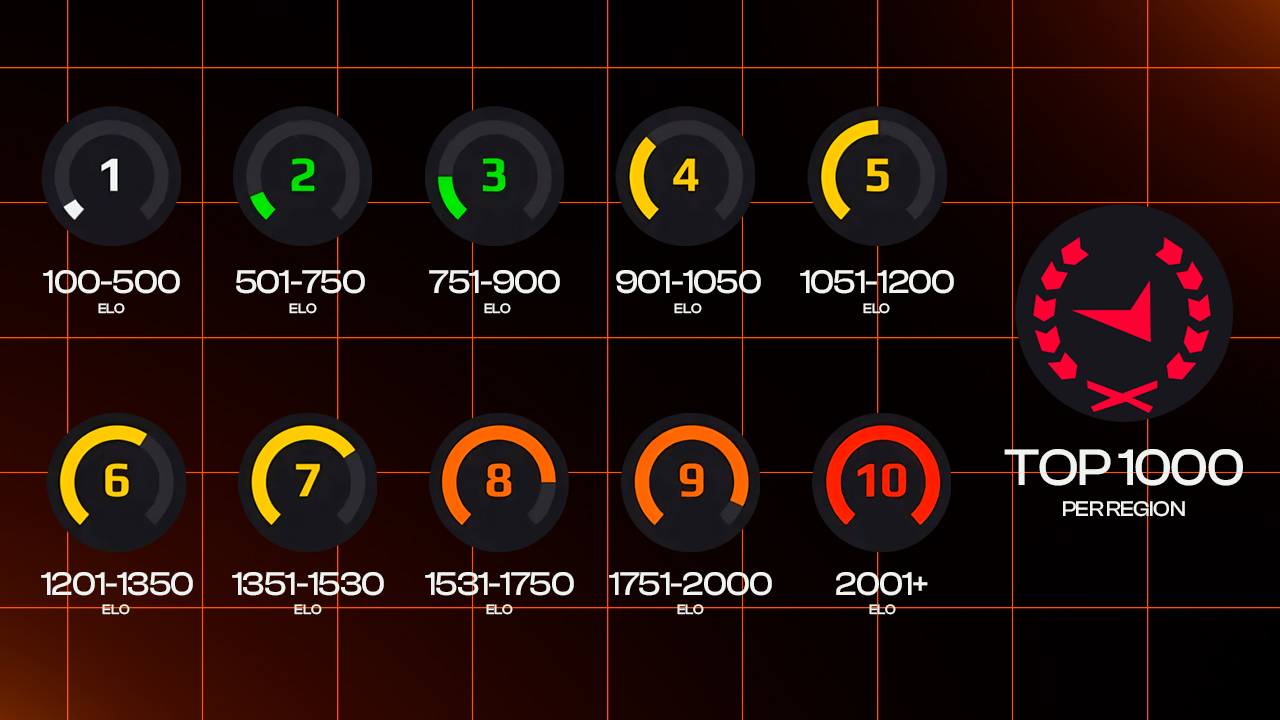
Les ranks FACEIT reposent sur deux systèmes liés : l’Elo FACEIT et les Skill Levels. L’Elo est le rating numérique de la plateforme, qui commence à 100 et augmente ou diminue selon les résultats des matchs. Contrairement aux badges de rank fixes, l’Elo n’a pas de limite supérieure, donc les joueurs très forts peuvent continuer à gagner du rating au-delà de la structure de niveaux standard. Pour rendre ce rating plus facile à comprendre, FACEIT convertit l’Elo en 10 Skill Levels, où chaque niveau représente une plage d’Elo spécifique. Le Level 1 est le tier le plus bas, tandis que le Level 10 est le Skill Level régulier le plus élevé et regroupe la partie la plus forte de la base de joueurs ranked.
Au-dessus de la structure standard 1-10, FACEIT possède aussi Challenger, un statut réservé aux meilleurs joueurs évoluant au plus haut niveau de la plateforme. Les Skill Levels donnent un tier visuel, tandis que l’Elo montre la position exacte à l’intérieur ou au-delà de ce tier. Deux joueurs peuvent être Level 10 tous les deux, mais avoir des valeurs d’Elo très différentes, ce qui signifie que leur position réelle sur la plateforme peut aussi être très différente. L’Elo FACEIT n’a aucun lien avec les systèmes de classement officiels de Valve, y compris les ranks Matchmaking traditionnels et les ratings Premier. Ces systèmes ne se chevauchent pas, ne se transfèrent pas et ne s’influencent pas.
Tableau des ranks FACEIT CS2 : tous les niveaux et plages d’Elo
Les ranks FACEIT sont plus faciles à comprendre via les Skill Levels, mais le rating réel derrière chaque niveau reste basé sur l’Elo FACEIT. Chaque niveau représente une plage d’Elo fixe, en commençant par le Level 1 à 100 Elo et en allant jusqu’au Level 10 à partir de 2001 Elo. Les nouveaux utilisateurs FACEIT commencent au Level 4. Comme le Level 10 n’a pas de limite supérieure, deux joueurs du même niveau peuvent tout de même être séparés par des milliers de points d’Elo.
Level | Plage d’Elo | Tier de skill |
|---|---|---|
1 |
100-500 |
Débutant |
2 |
501-750 |
Débutant |
3 |
751-900 |
Bas intermédiaire |
4 |
901-1050 |
Intermédiaire (départ par défaut : 1000) |
5 |
1051-1200 |
Intermédiaire |
6 |
1201-1350 |
Intermédiaire supérieur |
7 |
1351-1530 |
Avancé |
8 |
1531-1750 |
Avancé |
9 |
1751-2000 |
Expert |
10 |
2001+ |
Élite (sans limite supérieure) |
Challenger |
Top 1 000 par région |
Pro / semi-pro |
Challenger se situe en dehors de la structure régulière 1-10 et est réservé aux 1 000 meilleurs joueurs de chaque région, ce qui en fait le niveau FACEIT le plus élevé de la plateforme.
How FACEIT Elo Works
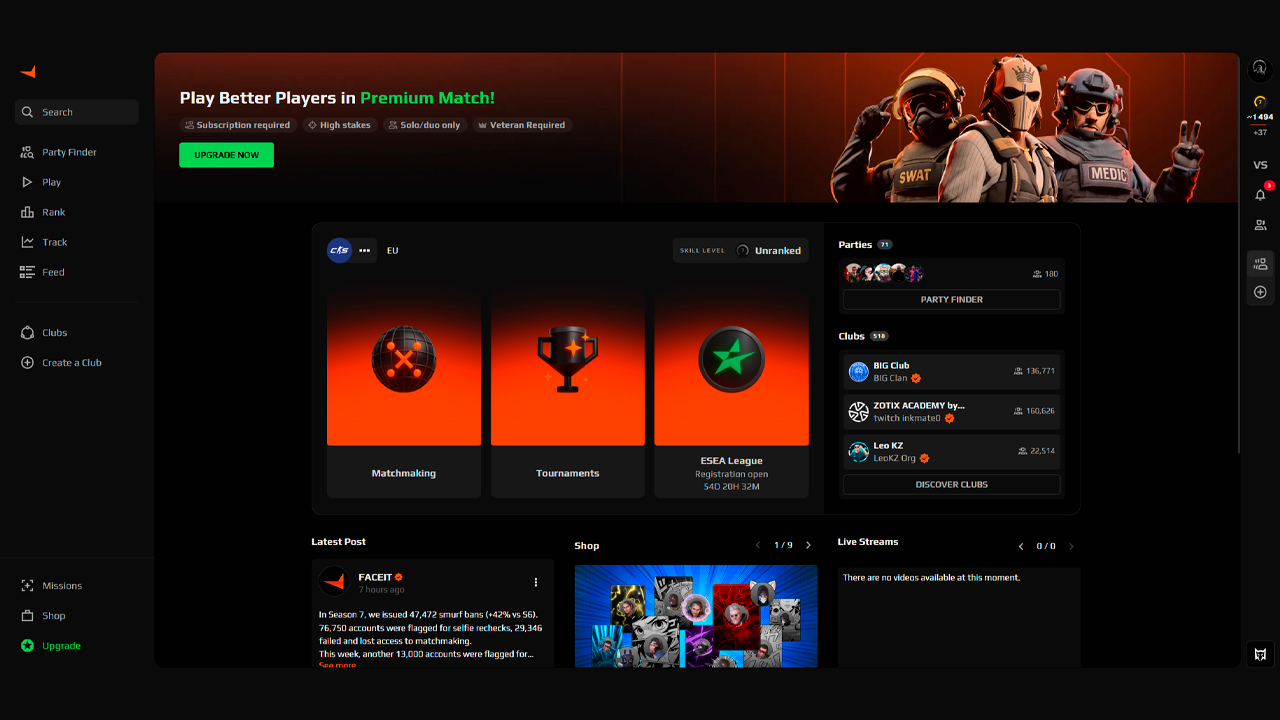
FACEIT Elo is the rating value that determines movement through FACEIT levels. A balanced match usually gives or removes around ±25 Elo, while uneven matches can change that amount: beating a stronger team brings a bigger reward, while losing to a weaker team costs more. Premium matches and Super Matches don’t use one fixed Elo value, since the final gain or loss still depends on the match’s predicted outcome and team balance.
Season 8 added more detail to the system, especially for players below Level 10. Match results still matter most, but FACEIT can now apply a small adjustment for strong individual impact in Levels 1-9. The goal is to recognize useful actions that influence rounds, such as opening kills, trades, support play, and effective utility usage.
- Levels 1-9: Individual impact can slightly affect Elo gains or losses. A strong match with high FACEIT Rating may reduce the loss in a defeat or increase the reward after a win.
- Level 10: Elo remains fully tied to wins and losses, without performance-based adjustment.
- FACEIT Rating: Season 8 uses clear rating examples: 1.4 means a very strong performance, 1.1 is around average, and 0.7 shows a weak match. The metric values entries, trades, utility, clutches, and other actions that shift round or match outcome, not only K/D.
- Leavers: Leaving a match can lead to bans and heavier Elo penalties, while teammates left in the game receive reduced Elo loss through mitigation.
At higher ranks, the system stays stricter, with Level 10 preserving a team-result focus to prevent stat-based play from becoming more important than winning rounds.
FACEIT Elo Chart: Where Each Level Sits
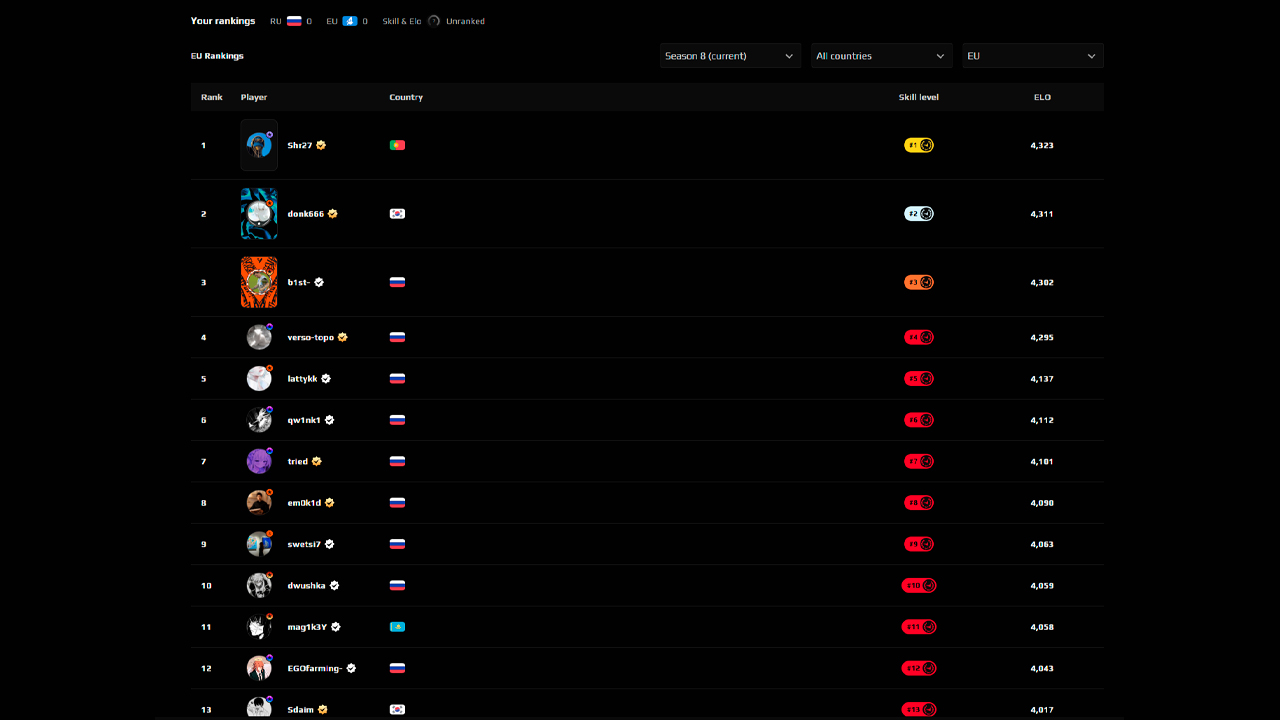
The FACEIT Elo chart shows how a player’s numerical rating translates into a rank on the platform. The chart works differently for different groups of players. For Levels 1-9, it mainly shows the current level, the current Elo number, and how much rating is needed to reach the next level. Once Level 10 is reached, the system can no longer show further progress through new levels. At that point, country and regional rankings become more important, especially for players close to the Challenger zone.
FACEIT also uses different charts and ladders for separate parts of the player base. Some ladders are grouped by level ranges, such as 1-3, 4-6, 7-8, 9, and 10. This makes each ladder more relevant by grouping players with comparable ratings instead of placing the entire platform into one shared leaderboard. Other rankings can focus on format, party size, win streaks, or specific competitive ladders. Because of that, a player’s position can change depending on which chart is being viewed.
In the upper range, the Elo chart shifts from basic level progression to direct competition between high-Level 10 and Challenger players. As of June 2026, first place belongs to donk, Danil Kryshkovets, Team Spirit’s rifler and one of the most prominent CS2 players in the professional scene.
FACEIT CS2 Rank Distribution
Level | % of Players |
|---|---|
1 |
1.2% |
2 |
4.8% |
3 |
7.2% |
4 |
11.7% |
5 |
11.3% |
6 |
10.5% |
7 |
11.0% |
8 |
11.5% |
9 |
10.4% |
10 |
20.4% |
FACEIT rank distribution doesn’t form a classic pyramid. Levels 4-9 are close in percentage because they represent the main middle and upper-middle part of the ranked player base. These levels have fixed Elo ranges, and many active players move between them as they improve, lose form, or stabilize around their current skill level.
Level 10 is now the most common FACEIT rank, representing 20.4% of active players, almost double its 10.5% share in the 2024 report. The increase shows how the upper end of the system has become more crowded over time. Since Level 10 has no upper Elo limit, both low-Level 10 accounts and players with several thousand Elo remain in the same rank group, making it larger than the fixed levels below. The distribution may also have changed again after the Season 8 launch on April 22, 2026, when all players had to complete 10 placement matches following a soft Elo reset.
FACEIT vs CS2 Premier Rating: Conversion Chart
CS2 Premier Rating and FACEIT levels can be compared only approximately. There’s no official public conversion chart between the two systems. However, the community estimates the conversion rate roughly as follows:
CS2 Premier Rating | Approx. FACEIT Level |
|---|---|
Under 5,000 |
Levels 1-3 |
5,000-10,000 |
Levels 3-5 |
10,000-15,000 |
Levels 5-7 |
15,000-20,000 |
Levels 7-9 |
20,000-30,000 |
Level 10 |
30,000+ |
Level 10 / Challenger |
Season 8 Changes (Since April 22, 2026)
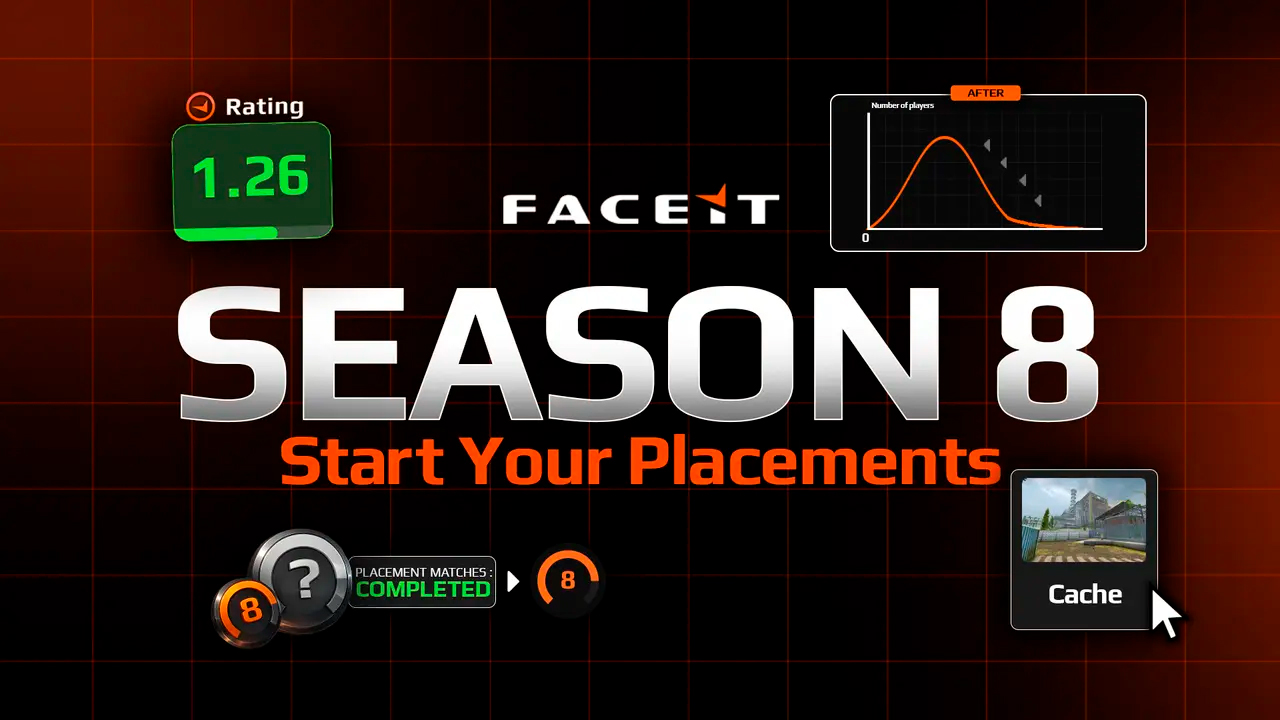
Season 8 changed FACEIT’s competitive structure by moving the platform to fixed 4-month cycles. This gives each season a clear endpoint, with rewards and leaderboard positions tied to a limited period instead of an endless climb. The update also introduced mandatory calibration matches for every player, including professionals. Before receiving a visible rank, each account must complete 10 placement matches. During calibration, Elo remains hidden, and the profile appears as Unranked. There’s no time limit for completing these matches, so players can finish the process at their own pace.
These changes also affected FACEIT rankings through a soft Elo reset. The strongest compression applied to players above 4000 Elo, moving them closer to the average Level 10 range to make the top of the ladder more competitive again. Levels 3-7 were affected much less and generally stayed close to their previous positions. Season 8 also added FACEIT Rating, a new impact-based metric that evaluates more than just kills, including multi-kills, opening frags, and trades. It now helps determine seasonal rewards and adds more context to player profiles, while Elo remains the main ranking value. Cache also returned to the competitive map pool and is available in both Matchmaking and Clans.
How to Rank Up Fast in FACEIT CS2
Ranking up fast in FACEIT depends on increasing win rate. Solo queue can work, but structured practice and stable teammates usually make progress faster.
- Play five-stack whenever possible: Regular teammates make communication, trading, and site executes more reliable.
- Review demos: Lost rounds show patterns in positioning, utility use, peeking, and mid-round decisions.
- Learn utility lineups: Smokes, flashes, and Molotovs help take space, stop pushes, and improve retakes.
- Avoid tilt queueing: Frustration leads to bad calls, rushed fights, and avoidable Elo losses.
- Narrow your map pool: Playing fewer maps makes roles, timings, and utility easier to learn.
- Use voice comms: Short and clear calls help with rotations, enemy positions, damage info, and retakes.
Challenger Rank: How It Works in 2026
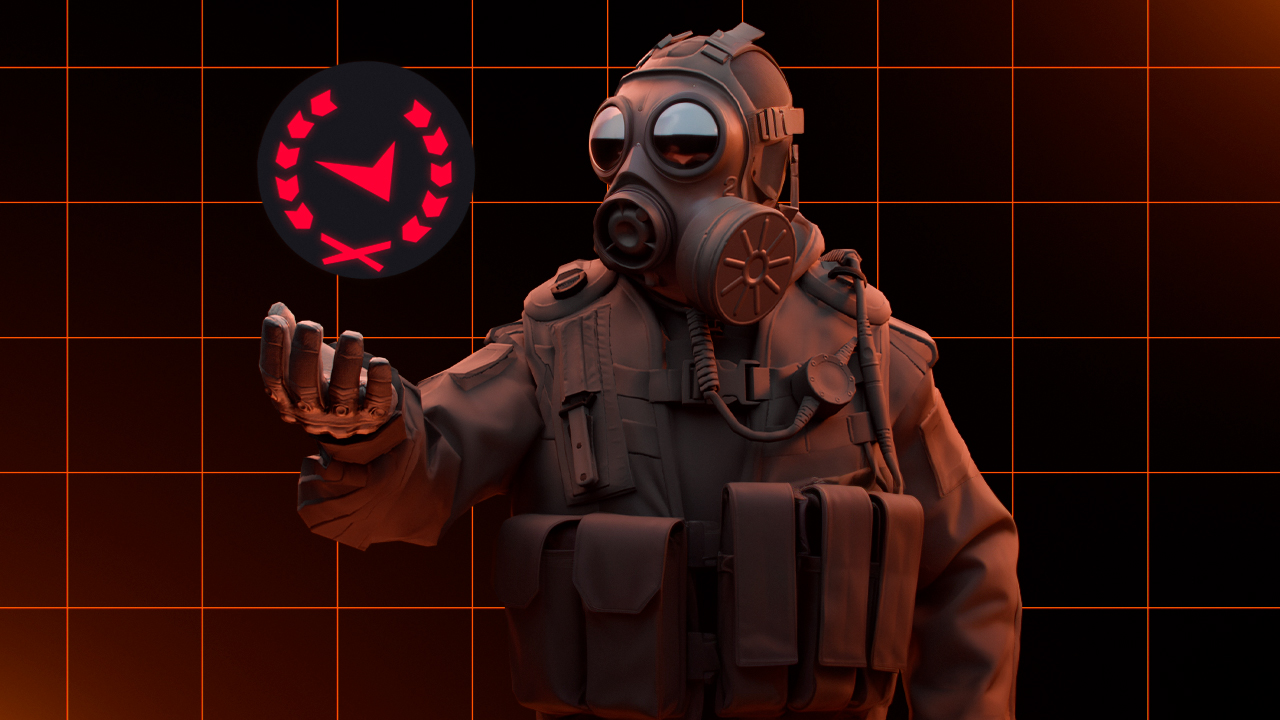
Challenger is placed above regular FACEIT Level 10 and is reserved for the highest-rated players on the platform. Level 10 begins at 2001 Elo and doesn’t have an upper limit, so the gap between players within this rank can be very large. Challenger solves this by separating the top 1,000 Level 10 players from the rest of the Level 10 pool. There’s no exact Elo number that guarantees Challenger status, since the rank depends on remaining within the top 1,000.
This also changes how progress is shown. Players in Levels 1-9 track their current level, Elo, and distance to the next level. Level 10 players below Challenger mainly track Elo, country ranking, and regional ranking. Once Challenger is reached, the focus shifts to the top of the leaderboard: the system shows how far a player is from first place and where they stand among other top accounts. In 2026, Challenger functions as a leaderboard status for players competing beyond standard Level 10.
Should You Switch from Premier to FACEIT?
Switching from Premier to FACEIT makes sense for players who want stricter competition, better communication, and a stronger focus on winning. It’s not the easier option, but it offers a more structured ranked environment than Premier. FACEIT is valued for its stronger anti-cheat measures, and matches usually attract players who take the game more seriously.
The difference is also visible in team play. Voice communication is more common, and players are more likely to trade, share info, and play for round wins instead of personal stats. The rating system also feels stricter, as players who consistently underperform are less likely to keep climbing through lucky matches. FACEIT also limits how much stronger players can carry weaker teammates up the ladder. However, there are drawbacks. Placement matches are required, and teammates can be more toxic because results matter more. The map pool can also feel less predictable, since map bans require a FACEIT subscription.
FAQ
-
Qu’est-ce que FACEIT Level 10 ?
FACEIT Level 10 est le Skill Level numéroté le plus élevé de la plateforme, à partir de 2001 Elo. Il n’a pas de limite supérieure, donc des joueurs avec des ratings très différents peuvent tout de même partager le même badge Level 10.
-
Combien y a-t-il de FACEIT Level 10 ?
Le Level 10 représente environ 20,4 % des joueurs FACEIT actifs. Cela en fait l’un des plus grands groupes de rank, principalement parce que tous les joueurs au-dessus de 2001 Elo restent dans le même niveau ouvert.
-
Quel est le plus haut niveau FACEIT ?
Le plus haut niveau numéroté est le Level 10, mais Challenger se situe au-dessus comme rank supérieur séparé. Challenger n’est pas un Level 11. C’est un statut basé sur le leaderboard, réservé aux joueurs Level 10 les mieux classés.
-
Comment fonctionne l’Elo FACEIT ?
L’Elo FACEIT augmente après les victoires et diminue après les défaites, avec un changement exact basé sur la force attendue des deux équipes. Un match équilibré change généralement d’environ 25 Elo, même si ce nombre peut varier si une équipe était favorite.
-
À quoi ressemble le FACEIT Elo chart ?
Le FACEIT Elo chart relie les plages de rating aux Skill Levels, en commençant à 100-500 Elo au Level 1 et en atteignant 2001+ Elo au Level 10. Comme le Level 10 n’a pas de limite, un Elo plus élevé influence surtout la position dans le leaderboard plutôt que de créer un autre niveau régulier.



![Nouveaux caisses CS2 : liste et dates de sortie [2026]](https://community.skin.club/wp-content/uploads/2026/05/Main-x-Name-768x432.jpg)
![Paramètres du radar dans CS2: Guide complet [2026]](https://community.skin.club/wp-content/uploads/2023/10/Main-x-Name-18-768x432.jpg)
![Desert Eagle Trempe jaspée Guide CS2 & Motifs [2026]](https://community.skin.club/wp-content/uploads/2024/10/Main-x-Name-9-768x432.jpg)