

FACEIT has become the leading third-party platform for CS2, effectively replacing official matchmaking for most competitive players, including pros, semi-pros, and serious grinders focused on improvement and winning. FACEIT’s reputation also comes from its security standards: its anti-cheat system is generally considered much stronger than Valve’s official VACNET, which makes the platform more trusted for competitive ranked matches. After the Season 8 update, FACEIT levels and ranks operate under a refreshed competitive structure built around tiers, Elo calculation, Challenger status, and stricter progression rules. The connection between these systems defines how players move through FACEIT, gain rating over time, and reach more competitive matches.
What Are FACEIT CS2 Ranks?
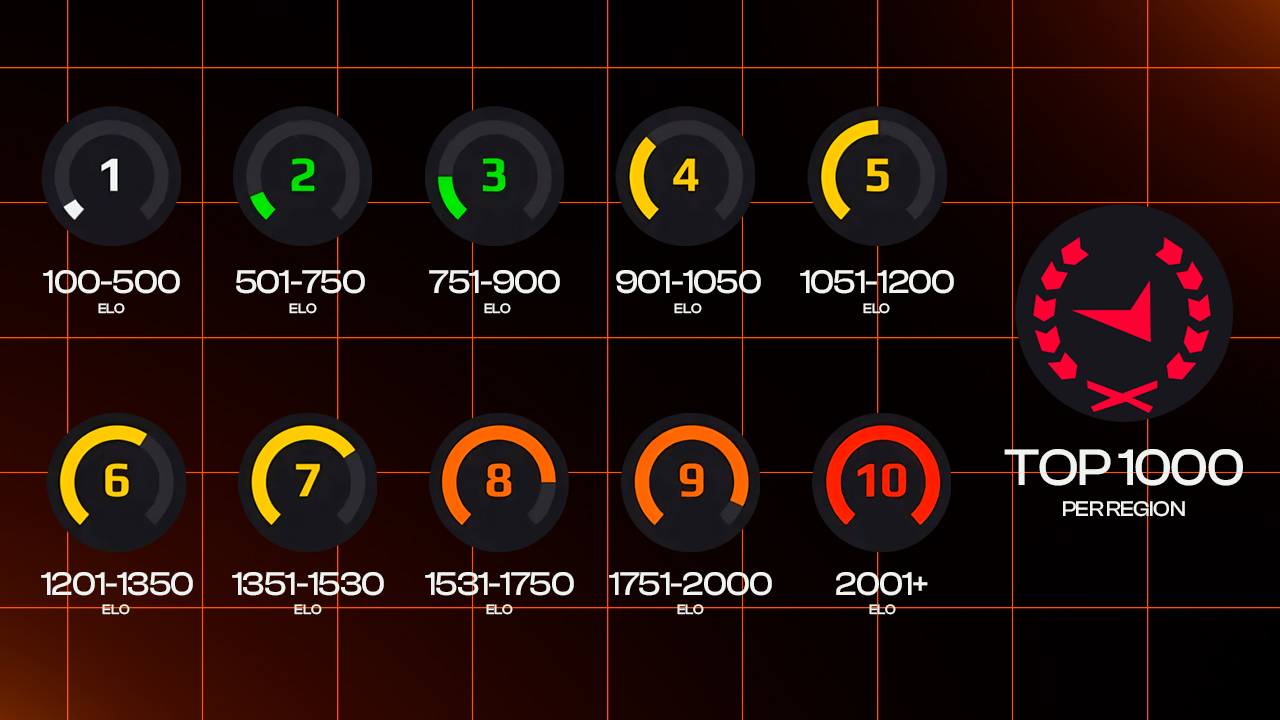
FACEIT ranks are built around two connected systems: FACEIT Elo and Skill Levels. Elo is the platform’s numerical rating, starting at 100 and increasing or decreasing based on match results. Unlike fixed rank badges, Elo doesn’t have an upper limit, so highly skilled players can continue gaining rating beyond the standard level structure. To make this rating easier to understand, FACEIT converts Elo into 10 Skill Levels, where each level represents a specific Elo range. Level 1 is the lowest tier, while Level 10 is the highest regular Skill Level and includes the strongest part of the ranked player base.
Above the standard 1-10 structure, FACEIT also has Challenger, a status reserved for top players competing at the highest end of the platform. Skill Levels provide a visual tier, while Elo shows the exact position within or beyond that tier. Two players can both be Level 10, but their Elo values may differ significantly, meaning their actual standing on the platform can also be very different. FACEIT Elo has no connection to Valve’s official ranking systems, including traditional Matchmaking ranks and Premier ratings. These systems don’t overlap, transfer, or influence each other in any way.
FACEIT CS2 Ranks Table: All Levels & Elo Ranges
FACEIT ranks are easier to understand through Skill Levels, but the actual rating behind every level is still based on FACEIT Elo. Each level represents a fixed Elo range, starting from Level 1 at 100 Elo and moving up to Level 10 at 2001 Elo and above. New FACEIT users start at Level 4. Since Level 10 has no upper limit, two players in the same level can still be separated by thousands of Elo points.
Level | Elo Range | Skill Tier |
|---|---|---|
1 |
100-500 |
Beginner |
2 |
501-750 |
Beginner |
3 |
751-900 |
Low intermediate |
4 |
901-1050 |
Intermediate (default start: 1000) |
5 |
1051-1200 |
Intermediate |
6 |
1201-1350 |
Upper intermediate |
7 |
1351-1530 |
Advanced |
8 |
1531-1750 |
Advanced |
9 |
1751-2000 |
Expert |
10 |
2001+ |
Elite (no upper cap) |
Challenger |
Top 1,000 per region |
Pro / semi-pro |
Challenger sits outside the regular 1-10 structure and is reserved for the top 1,000 players in each region, making it the highest FACEIT level on the platform.
How FACEIT Elo Works
FACEIT Elo is the rating value that determines movement through FACEIT levels. A balanced match usually gives or removes around ±25 Elo, while uneven matches can change that amount: beating a stronger team brings a bigger reward, while losing to a weaker team costs more. Premium matches and Super Matches don’t use one fixed Elo value, since the final gain or loss still depends on the match’s predicted outcome and team balance.
Season 8 added more detail to the system, especially for players below Level 10. Match results still matter most, but FACEIT can now apply a small adjustment for strong individual impact in Levels 1-9. The goal is to recognize useful actions that influence rounds, such as opening kills, trades, support play, and effective utility usage.
- Levels 1-9: Individual impact can slightly affect Elo gains or losses. A strong match with high FACEIT Rating may reduce the loss in a defeat or increase the reward after a win.
- Level 10: Elo remains fully tied to wins and losses, without performance-based adjustment.
- FACEIT Rating: Season 8 uses clear rating examples: 1.4 means a very strong performance, 1.1 is around average, and 0.7 shows a weak match. The metric values entries, trades, utility, clutches, and other actions that shift round or match outcome, not only K/D.
- Leavers: Leaving a match can lead to bans and heavier Elo penalties, while teammates left in the game receive reduced Elo loss through mitigation.
At higher ranks, the system stays stricter, with Level 10 preserving a team-result focus to prevent stat-based play from becoming more important than winning rounds.
FACEIT Elo Chart: Where Each Level Sits
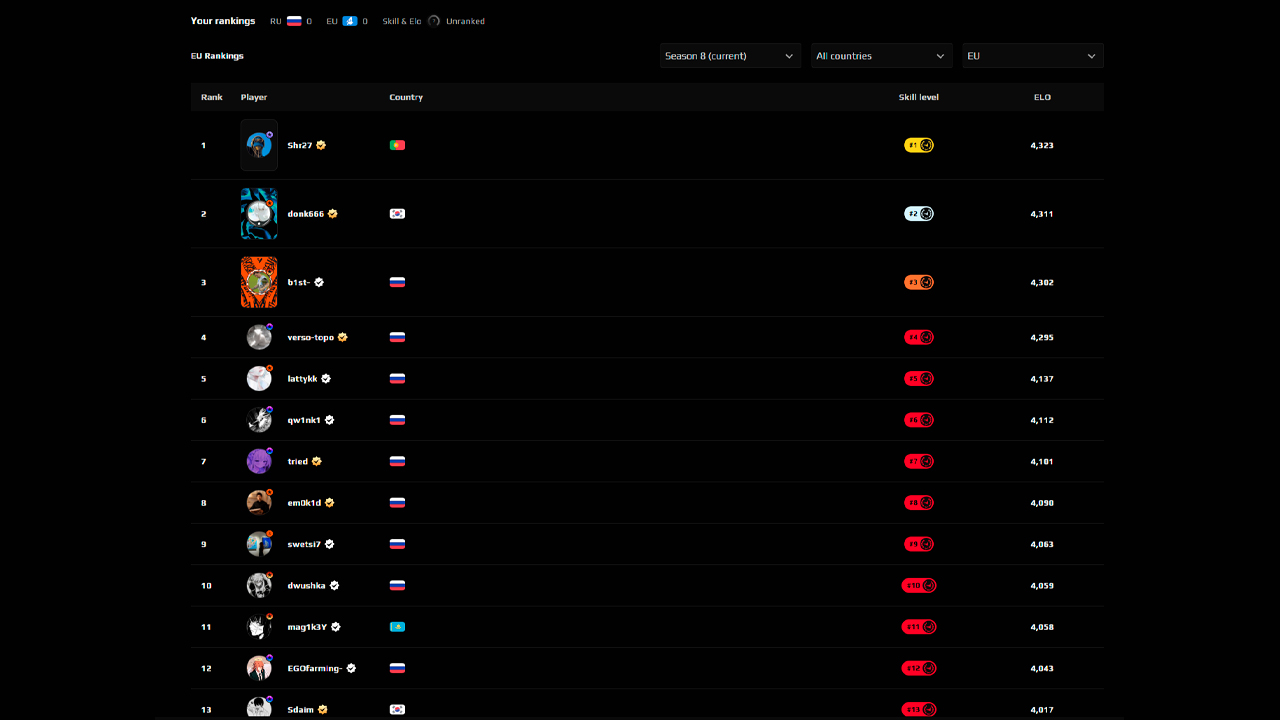
The FACEIT Elo chart shows how a player’s numerical rating translates into a rank on the platform. The chart works differently for different groups of players. For Levels 1-9, it mainly shows the current level, the current Elo number, and how much rating is needed to reach the next level. Once Level 10 is reached, the system can no longer show further progress through new levels. At that point, country and regional rankings become more important, especially for players close to the Challenger zone.
FACEIT also uses different charts and ladders for separate parts of the player base. Some ladders are grouped by level ranges, such as 1-3, 4-6, 7-8, 9, and 10. This makes each ladder more relevant by grouping players with comparable ratings instead of placing the entire platform into one shared leaderboard. Other rankings can focus on format, party size, win streaks, or specific competitive ladders. Because of that, a player’s position can change depending on which chart is being viewed.
In the upper range, the Elo chart shifts from basic progression to direct competition between high-level and Challenger players. The FACEIT leaderboard reflects the highly volatile nature of competitive rankings, where the best players shift positions based on recent performance and activity. This makes the Elo chart especially dynamic at the top, as leading positions are never fully fixed and can change quickly as elite players continue to compete.
FACEIT CS2 Rank Distribution
Level | % of Players |
|---|---|
1 |
1.2% |
2 |
4.8% |
3 |
7.2% |
4 |
11.7% |
5 |
11.3% |
6 |
10.5% |
7 |
11.0% |
8 |
11.5% |
9 |
10.4% |
10 |
20.4% |
FACEIT rank distribution doesn’t form a classic pyramid. Levels 4-9 are close in percentage because they represent the main middle and upper-middle part of the ranked player base. These levels have fixed Elo ranges, and many active players move between them as they improve, lose form, or stabilize around their current skill level.
Level 10 is now the most common FACEIT rank, representing 20.4% of active players, almost double its 10.5% share in the 2024 report. The increase shows how the upper end of the system has become more crowded over time. Since Level 10 has no upper Elo limit, both low-Level 10 accounts and players with several thousand Elo remain in the same rank group, making it larger than the fixed levels below. The distribution may also have changed again after the Season 8 launch on April 22, 2026, when all players had to complete 10 placement matches following a soft Elo reset.
FACEIT vs CS2 Premier Rating: Conversion Chart
CS2 Premier Rating and FACEIT levels can be compared only approximately. There’s no official public conversion chart between the two systems. However, the community estimates the conversion rate roughly as follows:
CS2 Premier Rating | Approx. FACEIT Level |
|---|---|
Under 5,000 |
Levels 1-3 |
5,000-10,000 |
Levels 3-5 |
10,000-15,000 |
Levels 5-7 |
15,000-20,000 |
Levels 7-9 |
20,000-30,000 |
Level 10 |
30,000+ |
Level 10 / Challenger |
Season 8 Changes (Since April 22, 2026)
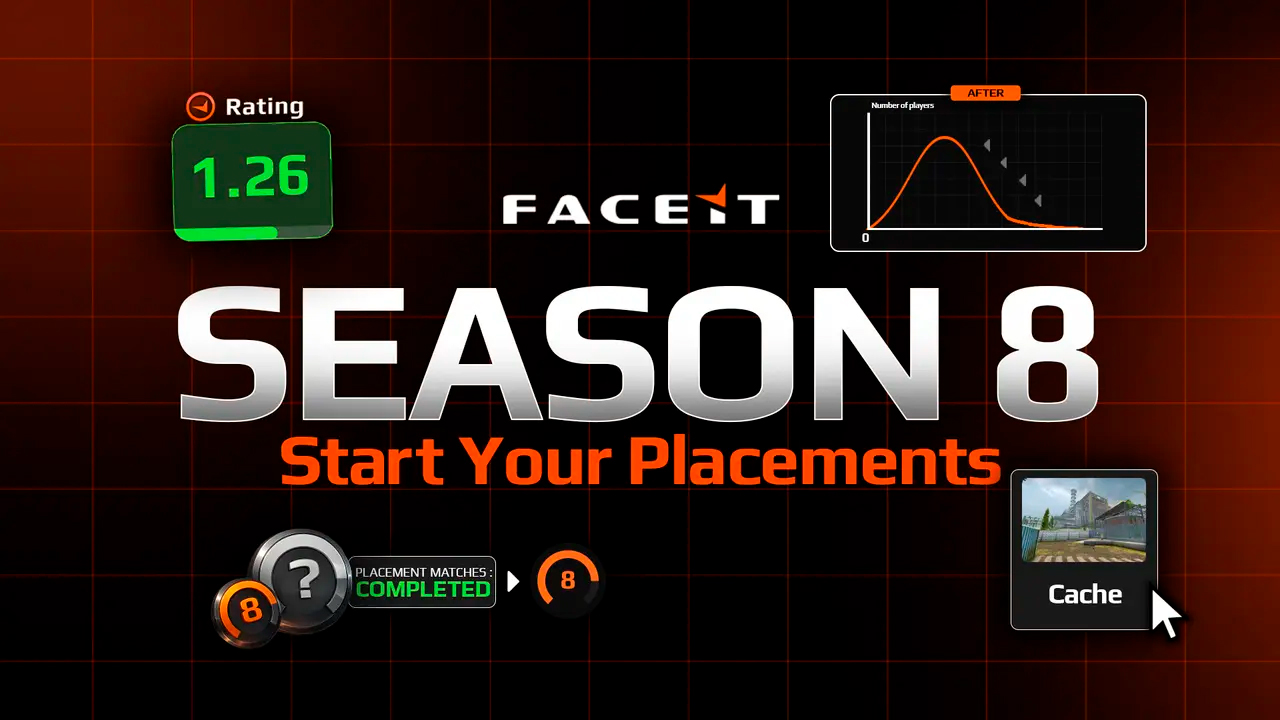
Season 8 changed FACEIT’s competitive structure by moving the platform to fixed 4-month cycles. This gives each season a clear endpoint, with rewards and leaderboard positions tied to a limited period instead of an endless climb. The update also introduced mandatory calibration matches for every player, including professionals. Before receiving a visible rank, each account must complete 10 placement matches. During calibration, Elo remains hidden, and the profile appears as Unranked. There’s no time limit for completing these matches, so players can finish the process at their own pace.
These changes also affected FACEIT rankings through a soft Elo reset. The strongest compression applied to players above 4000 Elo, moving them closer to the average Level 10 range to make the top of the ladder more competitive again. Levels 3-7 were affected much less and generally stayed close to their previous positions. Season 8 also added FACEIT Rating, a new impact-based metric that evaluates more than just kills, including multi-kills, opening frags, and trades. It now helps determine seasonal rewards and adds more context to player profiles, while Elo remains the main ranking value. Cache also returned to the competitive map pool and is available in both Matchmaking and Clans.
How to Rank Up Fast in FACEIT CS2
Ranking up fast in FACEIT depends on increasing win rate. Solo queue can work, but structured practice and stable teammates usually make progress faster.
- Play five-stack whenever possible: Regular teammates make communication, trading, and site executes more reliable.
- Review demos: Lost rounds show patterns in positioning, utility use, peeking, and mid-round decisions.
- Learn utility lineups: Smokes, flashes, and Molotovs help take space, stop pushes, and improve retakes.
- Avoid tilt queueing: Frustration leads to bad calls, rushed fights, and avoidable Elo losses.
- Narrow your map pool: Playing fewer maps makes roles, timings, and utility easier to learn.
- Use voice comms: Short and clear calls help with rotations, enemy positions, damage info, and retakes.
Challenger Rank: How It Works in 2026
Challenger is placed above regular FACEIT Level 10 and is reserved for the highest-rated players on the platform. Level 10 begins at 2001 Elo and doesn’t have an upper limit, so the gap between players within this rank can be very large. Challenger solves this by separating the top 1,000 Level 10 players from the rest of the Level 10 pool. There’s no exact Elo number that guarantees Challenger status, since the rank depends on remaining within the top 1,000.
This also changes how progress is shown. Players in Levels 1-9 track their current level, Elo, and distance to the next level. Level 10 players below Challenger mainly track Elo, country ranking, and regional ranking. Once Challenger is reached, the focus shifts to the top of the leaderboard: the system shows how far a player is from first place and where they stand among other top accounts. In 2026, Challenger functions as a leaderboard status for players competing beyond standard Level 10.
Should You Switch from Premier to FACEIT?
Switching from Premier to FACEIT makes sense for players who want stricter competition, better communication, and a stronger focus on winning. It’s not the easier option, but it offers a more structured ranked environment than Premier. FACEIT is valued for its stronger anti-cheat measures, and matches usually attract players who take the game more seriously.
The difference is also visible in team play. Voice communication is more common, and players are more likely to trade, share info, and play for round wins instead of personal stats. The rating system also feels stricter, as players who consistently underperform are less likely to keep climbing through lucky matches. FACEIT also limits how much stronger players can carry weaker teammates up the ladder. However, there are drawbacks. Placement matches are required, and teammates can be more toxic because results matter more. The map pool can also feel less predictable, since map bans require a FACEIT subscription.
FAQ
-
What is FACEIT Level 10?
FACEIT Level 10 is the highest numbered Skill Level on the platform, starting at 2001 Elo. It doesn’t have an upper limit, so players with very different ratings can still share the same Level 10 badge.
-
How many FACEIT Level 10s are there?
Level 10 makes up about 20.4% of active FACEIT players. This makes it one of the largest rank groups, mainly because all players above 2001 Elo remain within the same open-ended level.
-
What is the highest FACEIT level?
The highest numbered level is Level 10, but Challenger sits above it as a separate top rank. Challenger isn’t Level 11. It’s a leaderboard-based status reserved for the highest-rated Level 10 players.
-
How does FACEIT Elo work?
FACEIT Elo increases after wins and decreases after losses, with the exact change based on the expected strength of both teams. A balanced match usually changed by around 25 Elo, although the number can vary if one team was favored.
-
What does the FACEIT Elo chart look like?
The FACEIT Elo chart connects rating ranges to Skill levels, starting from 100-500 Elo at Level 1 and reaching 2001+ Elo at Level 10. Since Level 10 has no cap, higher Elo mainly affects leaderboard position rather than creating another regular level.



![Newest CS2 Cases: List & Release Dates [2026]](https://community.skin.club/wp-content/uploads/2026/05/Main-x-Name-768x432.jpg)
![M4A1-S Fade Pattern Guide: All Seeds & Full Fade [2026]](https://community.skin.club/wp-content/uploads/2024/10/Main-x-Name-1-4-768x432.jpg)