
CS2 has two separate ranking systems that operate independently, and players often get confused between them. The game splits competitive progression between map-specific ranks in classic Competitive mode and numerical Premier Rating in Premier mode. In CS:GO, a single rank covered everything. Understanding how CS2 ranks work in each system is what separates players who climb efficiently from those who grind without progress.
The ranking system is based on a principle that takes into account the player’s gaming skills (positioning, trading, utility usage etc.), and the number of hours played does not affect the upward movement in the ranking. Competitive ranks are tied to individual maps, meaning players can be highly ranked on Mirage and still be unranked on Nuke. Premier mode uses a visible CS2 rating number that updates after every match, making progress or regression immediately clear.
The Two CS2 Ranking Systems: Premier and Competitive
Competitive mode assigns a separate rank for each map. This means that progress on Inferno does not influence Dust 2. Ranks start at Silver I and go up to Global Elite, consisting of 18 tiers. MMR is hidden, meaning the exact number of points gained or lost per match is not displayed. Competitive mode is available for free. To receive your first rank on a map, you need 10 wins in placement matches.
Premier mode works differently. Instead of fixed tiers, it uses a single numerical CS Rating that applies across all maps. This rating is updated after every match, and the exact number of points gained or lost is visible immediately. Each match begins with a pick-and-ban process, in which both teams take turns eliminating maps from the pool. The mode requires Prime status. Your first CS Rating is also assigned after winning 10 placement matches.
The table below visualizes the key features of each ranking system:
Feature | Competitive | Premier |
|---|---|---|
Rank type |
18 Ranks |
Numerical CS Rating |
Linking to maps |
Yes, separate rank on every map |
No |
Progress visibility |
Hidden MMR |
Gained/lost points are visible |
Requirement |
Free |
Need Prime Status |
How to Get Your First Rank in CS2
Both systems require exactly 10 placement matches to assign a rank. A single match is not enough, as the rank is not displayed until all 10 are completed. The starting rank is determined by the results of those matches and individual performance stats, meaning win rate, kills, and overall impact across the 10 games are taken into account. Two players can complete their placements with the same number of wins and still end up at different ranks based on personal performance.
CS2 Competitive Ranks
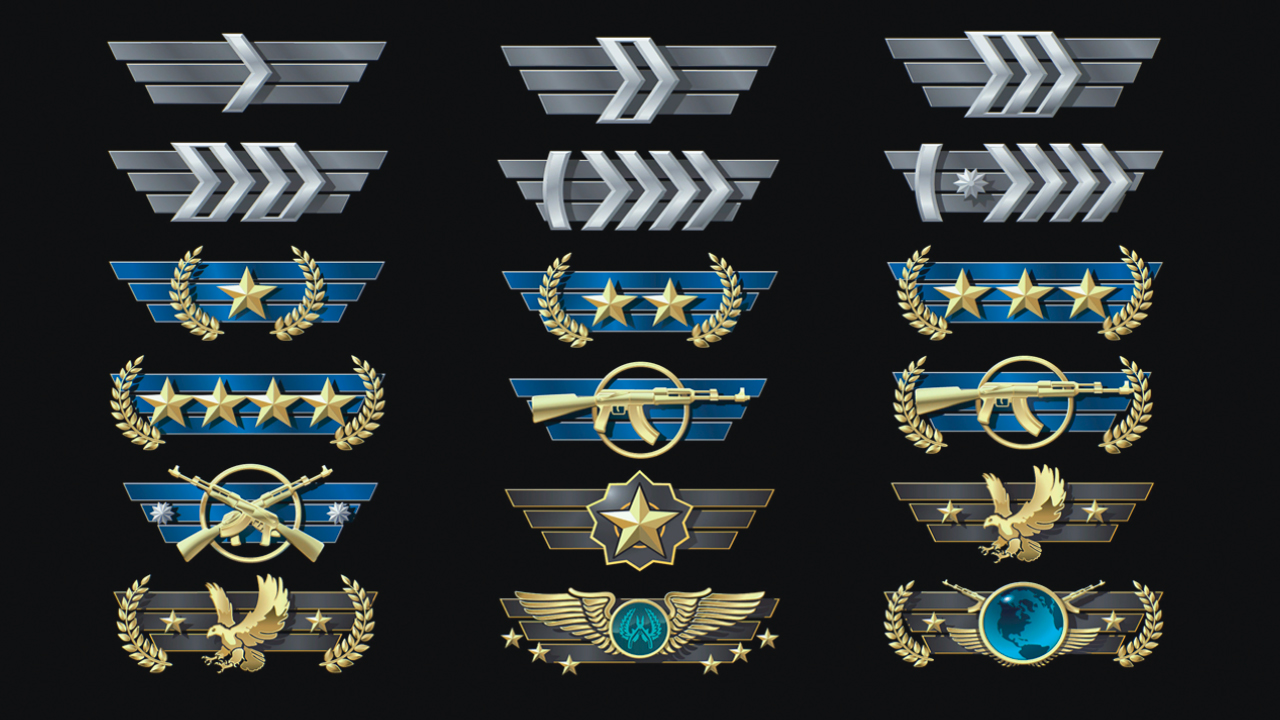
There are 18 competitive ranks, divided into four groups: Silver (6 ranks), Gold Nova (4 ranks), Master Guardian (4 ranks) and Elite tier (4 ranks).
Silver 1 to Silver Elite Master
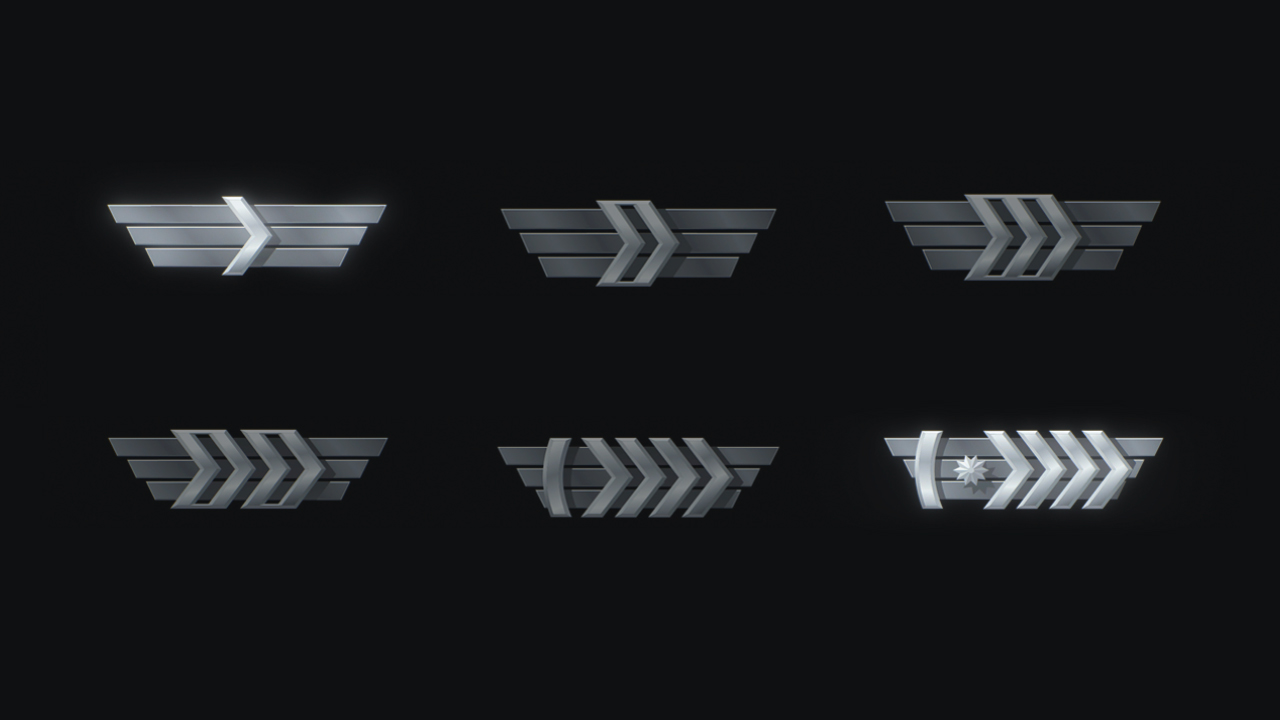
Players at this level include Silver I, Silver II, Silver III, Silver IV, Silver Elite, and Silver Elite Master. At this stage, players are familiar with basic mechanics. They understand how to buy weapons, know the general layout of maps, and can secure kills in straightforward situations. The main issue is consistency. Crosshair placement tends to be reactive rather than proactive, utility usage is minimal or uncoordinated, and movement during gunfights is often a weak point. Players frequently fail to stop before shooting and continue moving, which reduces accuracy.
To move out of Silver, the most impactful area to improve is crosshair placement. Keeping the crosshair at head height and pre-aiming common angles removes the reaction-time gap that causes most lost duels at this level. Basic communication and clear callouts also accelerate progress faster than mechanical improvements alone.
Gold Nova 1 to Gold Nova Master
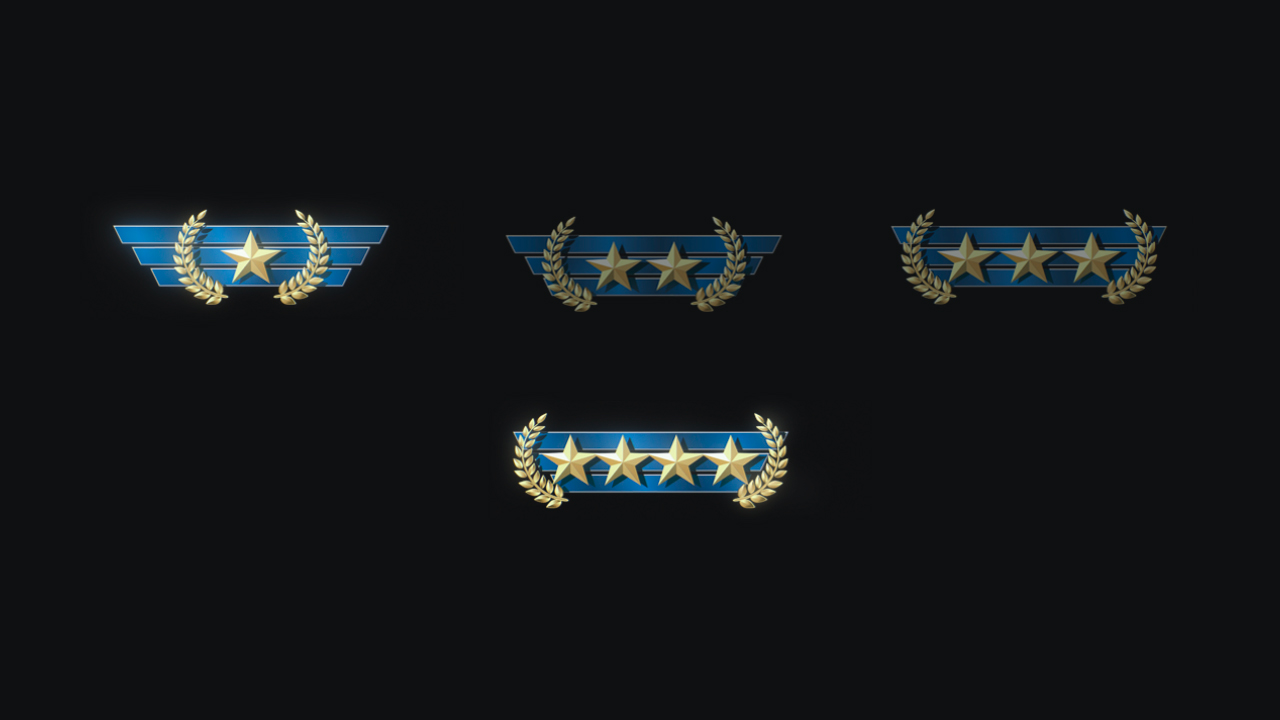
This group includes Gold Nova I, Gold Nova II, Gold Nova III, and Gold Nova Master. Players at this level already understand how team play is supposed to work. They know that utility should be coordinated, kills should be traded, and rounds should follow a structure. The main problem is that understanding rarely translates into consistent execution. Decisions to push or hold are often made individually rather than as a unit, and timing falls apart in mid-round situations. Mechanics are noticeably better than in Silver, but inconsistency in duels remains, especially in non-standard scenarios.
Progressing further is less about individual skill and more about discipline. This means holding positions, avoiding unnecessary solo pushes, and playing rounds according to the plan even when the situation becomes unfavorable. Players who climb out of Gold Nova faster than others generally don’t have better mechanics, they simply make fewer random decisions.
Master Guardian 1 to Distinguished Master Guardian
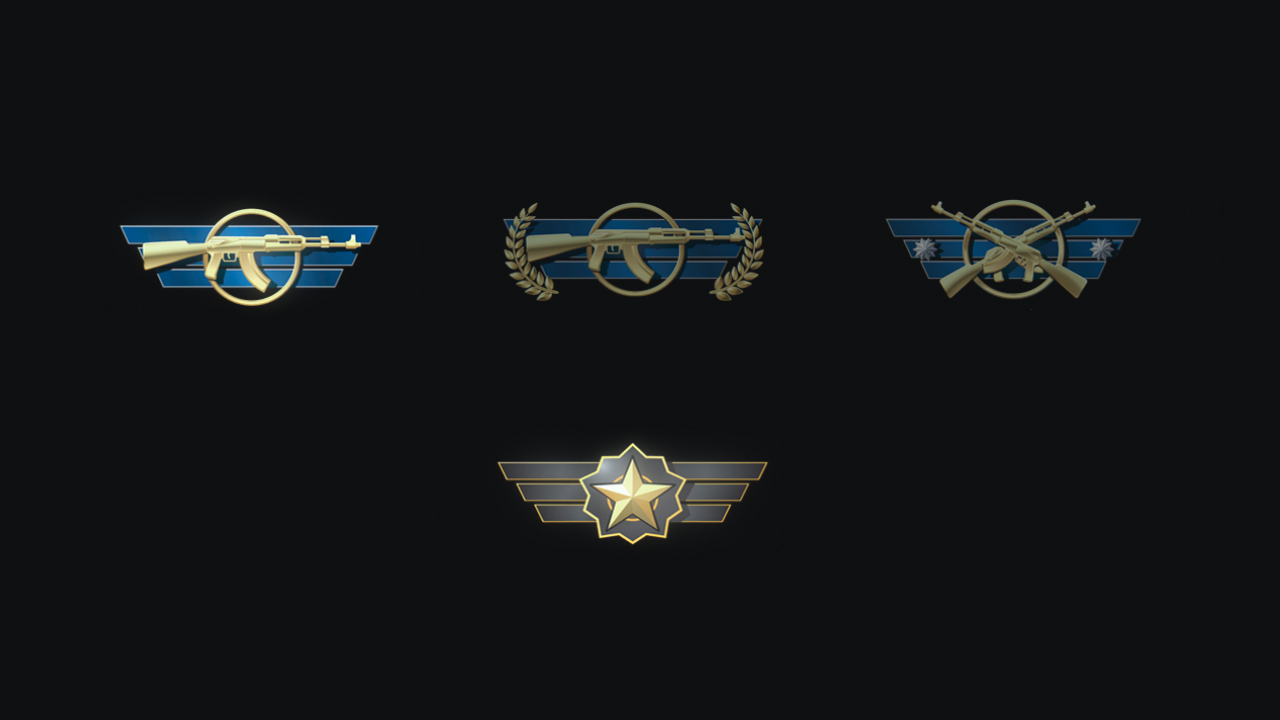
Players in this group are distributed across the following ranks: Master Guardian I, Master Guardian II, Master Guardian Elite, and Distinguished Master Guardian. At this level, advanced mechanics stop being theoretical and become consistent habits. Players reliably pre-aim angles, manage the economy with intention, and use utility as part of a structured plan rather than reacting to situations as they develop. Teamplay becomes more organized, and kill trading happens naturally without reminders. The main weaknesses at this level lie in decision-making during non-standard situations and in reading the opponent’s strategy. To improve further, players begin to analyze demos, focus on specific maps, and treat each match as a source of information.
Legendary Eagle

This is the first rank where an intuitive understanding of the game becomes essential. Players can read opponents and control the pace of rounds.
Legendary Eagle Master

Players at this rank perform similarly to those in Legendary Eagle. The difference is defined by stronger discipline and more consistent decision-making.
Supreme Master First Class

High-skill players who can often teach others how to play CS2. Only around 3-4% of players reach this level.
Global Elite

Fewer than 1% of CS2 players reach this rank. Players at this level train systematically, study opponents, and do not rely on chance.
How Map-Specific Ranks Work
In Competitive Mode, rank is tied to a specific map. This means that a player can be Gold Nova on Mirage and Silver on Nuke. This system more accurately reflects a player’s real skill level. Each map has its own pace, layout, utility usage, and positional demands. Mirage and Nuke represent fundamentally different sets of knowledge, and a single combined rank would hide that difference.
Advantages of map-specific ranks:
- Encourages specialization: A player focused on one map climbs faster on it and is placed into more balanced lobbies.
- Reduces random matchmaking outcomes: Rank reflects actual map knowledge, which reduces the skill gap between players in the same lobby.
- Builds adaptability: Players who want to improve overall rather than focus on a single map are motivated to develop a wider map pool and improve on each map separately.
Rank Distribution in Competitive Mode
Based on data available in October, 2026, most of the players are concentrated between Silver I and Gold Nova Master. The most popular rank is Silver I because about 17% of players remain on it. To reach approximately the top 10, player needs to be at least Master Guardian II.
Rank group | Share of players |
|---|---|
Silver I to Silver Elite Master |
58% |
Gold Nova I to Gold Nova Master |
25.4% |
Master Guardian I to Distinguished Master Guardian |
12.8% |
Legendary Eagle |
1.4% |
Legendary Eagle Master |
1.5% |
Supreme Master First Class |
0.5% |
Global Elite |
0.4% |
CS2 Premier Rating
In Premier mode, CS2 uses a rating system in which players are assigned a numerical score that increases or decreases based on match results. This system is similar to Elo and works in a way comparable to FACEIT’s rating system. A win increases the rating, while a loss decreases it. This makes a player’s current skill level easier to understand and creates a more competitive environment. Progress depends on results and consistency.
Premier Rating Tiers and Colors
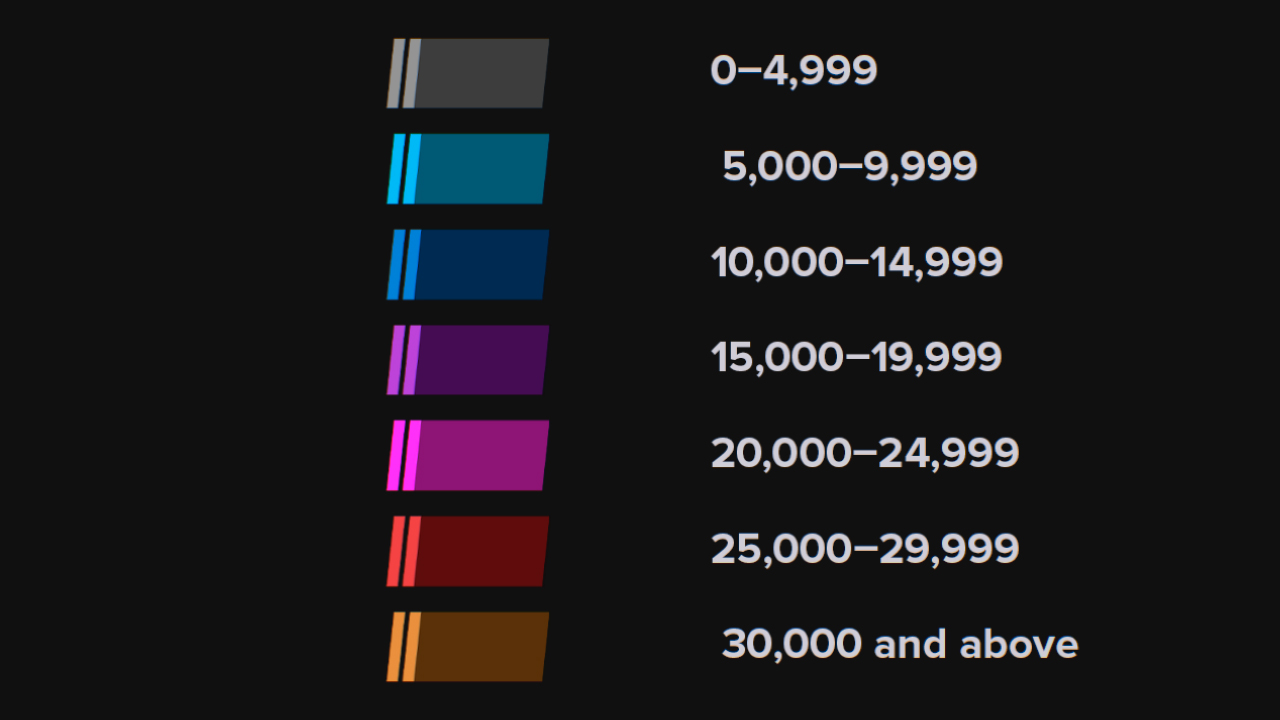
In CS2, Premier mode introduces a unique ranking system centered around CS Rating, offering a numerical representation of a player’s skill level. Starting at 1,000, CS Rating can go as high as 30,000 or more for top players, with tiers visually distinguished by colors:
- Gray: 0–4,999
- Light Blue: 5,000–9,999
- Blue: 10,000–14,999
- Purple: 15,000–19,999
- Pink: 20,000–24,999
- Red: 25,000–29,999
- Gold: 30,000 and above
Placement Matches in Premier
A total of 10 wins are required to receive your first CS Rating in Premier. The rating is not displayed until all placement matches are completed. The starting rating depends on the results of those matches and individual performance.
Each Premier match begins with a map pick-and-ban process. Each team takes turns banning maps from the pool. When all maps except one have been banned, the remaining map becomes the match map. In CS2 Premier, the pool consists of seven maps from the active map pool. Each team bans three maps, leaving one map to be played. This format is borrowed from the professional scene and gives teams direct influence over map selection. Matches are played in the MR12 format, where the first team to reach 13 rounds wins. A 12-12 tie is resolved through a six-round overtime.
Global and Regional Leaderboards
Leaderboards add an extra layer of competition, allowing players to compare their CS Ratings with friends, regionally, and globally. There are nine available leaderboards: Friends (players in your friends list), World, Africa, Asia, Europe, China, North America, South America, and Australia. This transparent and dynamic system not only reflects individual skill but also encourages continuous improvement and teamwork, making Premier mode a key part of CS2’s competitive experience.
Entry to a regional leaderboard is not based on a fixed universal number. The cutoff depends on the region and changes over time, as it reflects the current top players in that region. Public leaderboard trackers show these rankings as live top-1,000 lists that update regularly, meaning the minimum rating for entry moves up and down over time. As of October 2026, entry into the European leaderboard requires roughly 30,000+ CS Rating, although the exact cutoff fluctuates.
Only players with Prime Status can appear on public Counter-Strike 2 leaderboards. A player is shown on the leaderboard only when they are among the top 1,000 in their region.
Premier Rating Distribution
As of October 2026, the most populated tier in Premier mode is Blue (10,000–14,999), followed by Light Blue (5,000-9,999). A rating of 15,000 and above indicates above-average skill, while fewer than 2% of players reach 25,000 or higher.
Tier | Rating Range | % of Players |
|---|---|---|
Gray |
< 5,000 |
~20.1% |
Light Blue |
5,000–9,999 |
~23.3% |
Blue |
10,000–14,999 |
~26.5% |
Purple |
15,000–19,999 |
~19.7% |
Pink |
20,000–24,999 |
~8.5% |
Red |
25,000–29,999 |
~1.8% |
Gold |
30,000+ |
~0.1% |
Premier Rating to CS:GO Rank Conversion
The table shows common community-based comparisons between CS Premier Rating and CS:GO ranks. It is not an official Valve system and is based on community interpretation rather than Valve’s ranking rules.
CS Rating | Color | Equivalent CS:GO Rank |
|---|---|---|
< 4 999 |
Gray |
Silver I – Silver Elite Master |
5 000–9 999 |
Light Blue |
Gold Nova 1 – Gold Nova Master |
10 000–14 999 |
Blue |
Master Guardian 1 – Master Guardian Elite |
15 000–19 999 |
Purple |
Distinguished Master Guardian – Legendary Eagle |
20 000–24 999 |
Pink |
Legendary Eagle Master |
25 000–29 999 |
Red |
Supreme Master First Class |
30 000+ |
Gold |
Global Elite |
CS2 Profile Level (XP Ranks)
Profile Level is a separate system that has no effect on rank in Competitive or Premier mode. A high profile level does not indicate a high competitive rank and has no relation to matchmaking skill level. It is purely a measure of time spent in the game. XP is earned from matches in any mode, including Competitive, Premier, Deathmatch, and Casual. Profile level progresses from Private Rank 1 to Global Rank 40. Upon reaching level 40, the profile resets, and the player receives a Service Medal. This is an annual badge that reflects activity during the season. Each time level 40 is reached again, the medal changes color to mark continued progress.
How Does the CS2 Ranking System Work?
Both systems are affected by matchmaking values that are updated after each match, but are displayed to players differently. In Competitive, hidden MMR is not shown directly and its represented only by the player’s current rank. In Premier, players can see their current CS Rating after calibration. At the beginning of each match they can see the exact amount of rating they will receive for a win or lose for a defeat.
The main factor in rating changes is the match result. A secondary factor is personal performance, which includes kills, deaths, and damage.
Both modes include a rank decay system for inactive players. In Competitive, the rank is hidden after approximately one month of inactivity. Players report losing around two ranks upon return, although Valve does not publish the exact algorithm. In Premier, decay occurs faster, ranging from one to three weeks depending on the rating level. Winning a single match is enough to restore the rank or rating display in both modes.
CS2 vs CS:GO Ranking System: What Changed
There are three main differences. The first is the rating structure. CS:GO had a single ranking system that covered all maps and modes. CS2 introduced two independent systems. Competitive features classic ranks from Silver I to Global Elite, assigned to each map separately, and is available for free. Premier uses a numerical CS Rating that applies across all maps and includes a pick-and-ban system. Prime Status is required to access it.
The second key difference lies in how player skill is tracked. In CS:GO a single rank reflected a player’s overall level across all maps. In CS2, each map in Competitive has its own rank, and progress on one map does not affect another.
The third difference is transparency. In CS:GO, MMR progress was completely hidden, and players could not see how many points they gained or lost per match. In CS2, Premier Rating updates after every match and displays the exact number of points gained or lost.
FAQ
-
What is the difference between Competitive and Premier ranks in CS2?
The competitive rank system uses 18 classical ranks from Silver I to Global Elite. Premier uses a numerical CS Rating divided into color tiers. In Competitive a rank is assigned separately for each map and MMR is hidden while the Premier rating applies across all maps, and players can see the exact number of points gained or lost after every match. In addition to this, Competitive is available for free, but Premier requires Prime Status.
-
Can you lose your rank in CS2?
Yes. In Competitive mode, the rank is hidden after approximately 30 days of inactivity. In Premier, the rating disappears sooner, within one to three weeks depending on the rating level. In both cases the underlying MMR continues to decay in the background even while the rank is not displayed. Winning a single match is enough to restore the rank or rating icon.
-
What is the average CS2 rank?
The average player falls on the Gold Nova range in Competitive mode. In the Premier ranking system the most populated tier is Blue.
-
How many wins do you need to get a rank in CS2?
Both Competitive and Premier require 10 wins in placement matches. The rank or rating is not displayed until all 10 wins are completed. The starting rank depends on the results of those matches and individual performance.



![CS2 Chicken Eggs Explained: How Pets Work [2026]](https://community.skin.club/wp-content/uploads/2026/10/Main-x-Name-768x432.jpg)
![CS2 Weekly Drop Pool: Cases, Skins & How It Works [2026]](https://community.skin.club/wp-content/uploads/2025/10/Main-x-Name-11-768x432.jpg)
![Newest CS2 Cases: List & Release Dates [2026]](https://community.skin.club/wp-content/uploads/2026/05/Main-x-Name-768x432.jpg)