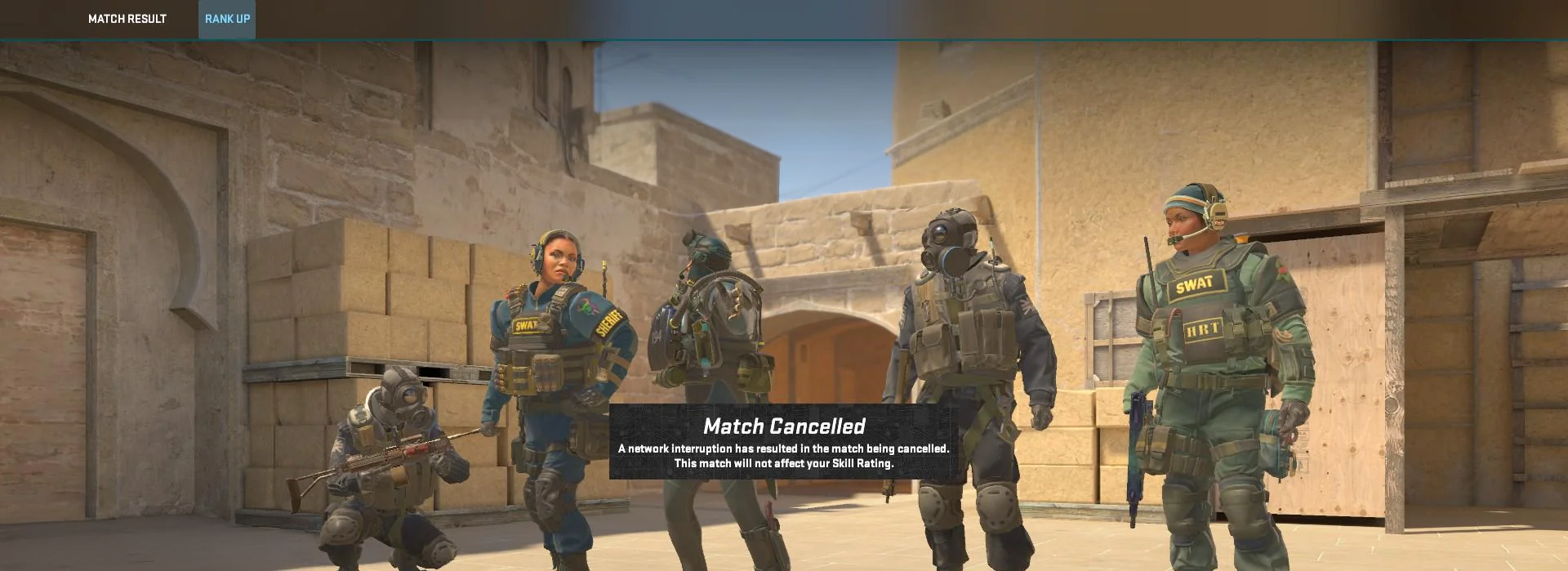

Valve continues to improve its anti-cheat systems in Counter-Strike 2, but players remain divided over their effectiveness. Recent VAC Live activity has sparked complaints about unexpected cooldowns, while others report sudden Trust Factor changes. Meanwhile, cheating remains a concern in Premier, especially at higher ratings.
However, these problems do not necessarily mean Valve’s systems are failing. Some players report successful cheat detections, while others question whether their punishments were justified. So, what is actually happening with VAC Live and Trust Factor, and can these systems become more reliable?

Why Are CS2 Players Receiving VAC Live Cooldowns?
VAC Live can cancel matches when it detects suspicious activity. Additionally, Valve’s VACNet system can issue temporary competitive cooldowns for irregular gameplay.
Unlike permanent VAC bans, these restrictions are temporary. According to Steam Support, they can last from 20 hours to 180 days, depending on previous detections. Following recent updates, several players reported receiving cooldowns despite claiming they had never used cheats.

One Reddit user described receiving a restriction after playing with the SSG 08 on Dust2.
I don’t cheat, and I’ve never cheated in any online or PvP game in my life. In CS2, I like playing with the SSG (Scout), and I’m pretty good with it.

The player also explained that opponents sometimes accused them of cheating after Scout kills or wallbangs. They questioned whether an irregular gameplay cooldown could eventually lead to a permanent ban.
Other players reported similar experiences involving the AWP. These complaints led to speculation that sniper rifles or unusual shooting patterns might trigger VACNet.
However, there is no confirmed evidence that using the Scout or AWP causes VAC Live cooldowns.
Another Reddit user reported receiving two restrictions for irregular gameplay. After investigating their setup, they suspected that connected peripherals might have contributed to the problem.
In my case what solved it, was unplugging the Xbox controller, as that stick drift might have sent a different input compared to the keyboard, and/or disabling a feature on logitech keyboard.
The player claimed to have completed four or five Competitive matches without further restrictions after making these changes.
Nevertheless, Valve has not confirmed any connection between these devices and VACNet detections.
Does This Mean VAC Live Is Broken?
Not necessarily. Reddit complaints alone cannot establish how frequently VAC Live makes mistakes.
Players who receive unexpected punishments have an obvious reason to share their experiences. Meanwhile, those who complete matches normally rarely discuss the absence of problems.
As a result, the number of complaints cannot be compared directly with the entire CS2 player base.
Another problem is verification. A cooldown screenshot confirms that a restriction occurred, but it cannot prove whether the player was cheating.
This disagreement is visible in another Reddit discussion. One user challenged players reporting false cooldowns to provide gameplay recordings from before and after the VAC update.
If you have received a vacnet cooldown and posted on reddit please provide stats, demo replay AND a demo replay before the vac update.
Some believe VACNet is incorrectly identifying legitimate gameplay. Others suspect that actual cheaters are attempting to present their restrictions as mistakes.
Still, there are examples of VAC Live working as intended.
In October, one player shared a screenshot showing how VAC cancelled a match after several reports against a suspected cheater.
vac cancelled the match after very obvious cheating, few reports and 5 rounds later it did the job. happy to see it

Such examples demonstrate the system’s ability to intervene during matches. However, individual successes do not establish its overall detection accuracy.
VACNet may continue improving as Valve adjusts its detection methods. Yet without official statistics, its current accuracy and false-positive rate remain unknown.
Why Is Trust Factor Still Causing Problems?
Trust Factor is another important part of Counter-Strike’s matchmaking system. Its purpose is to group players based on account trustworthiness and improve match quality.
However, Valve does not disclose its exact calculations. Players also cannot view their internal Trust Factor score.
Instead, they sometimes receive warnings when joining friends with significantly different trust levels. The community commonly describes these situations using green, yellow, and red categories.
In early October, multiple Reddit users reported sudden changes in these warnings. One player warned others against playing after an apparent wave of Trust Factor drops.
Valve pushed another shit update that is nuking random people’s trust facoter to hell! Be safe; don’t play until valve fixes their shit
Another user described an unusual experience in the comments.
Bro is that whats going on i had a game end due to “network issues” then tried to que with another friend and said i had bad trust factor
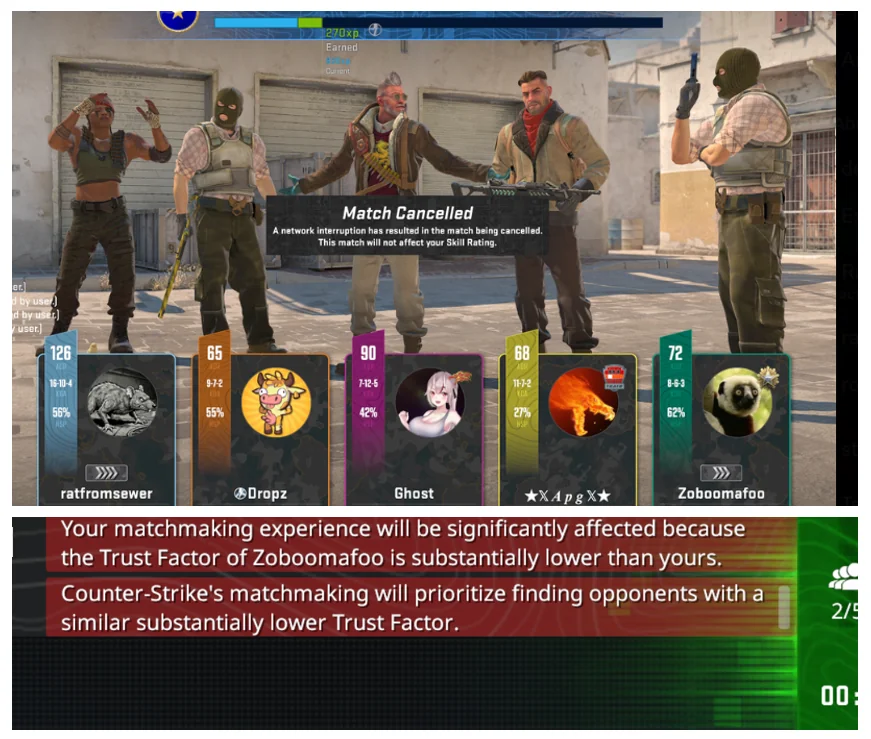
A different player with an 18-year-old Steam account also reported an unexpected change.
18 years old single account, never cheated, no bans/cooldowns – went from green to red trust factor overnight.

According to several users, their matchmaking experience worsened afterward. They reported encountering more suspected cheaters and toxic teammates.
However, Valve has not confirmed a widespread Trust Factor malfunction. Some players also reported that their warnings eventually disappeared.
The biggest problem is uncertainty. Without knowing how Trust Factor works, players struggle to understand why their matchmaking conditions change.
Why Do Players Still Encounter Cheaters?
Even players who believe they have good Trust Factor report encountering suspicious opponents.
One Reddit user with more than 26,000 Premier rating described their experience while attempting to reach 30,000 points.
Roughly 8 out of 10 matches are filled with players flagged with low trust on tracker networks, or just blatant spinbotters on accounts stacked with medals and high-tier skins.
The player also claimed to have encountered opponents who openly admitted to cheating without receiving permanent bans.
However, these are personal observations, not verified cheating statistics. Third-party tracker warnings also cannot confirm an account’s internal Valve Trust Factor.
Trust Factor cannot guarantee cheat-free matches. A player who has not been identified as cheating may still appear in regular matchmaking.
Moreover, VAC Live and Trust Factor serve different purposes. One detects suspicious activity, while the other helps determine matchmaking conditions.
Therefore, improvements to one system do not automatically solve every problem involving the other.

Can Valve Eventually Fix These Problems?
The recent controversy highlights how difficult it is to balance effective cheat detection with fair treatment of legitimate players.
VAC Live needs to identify suspicious behavior without incorrectly restricting innocent accounts. Meanwhile, Trust Factor must improve matchmaking without unfairly affecting legitimate players.
Both systems could become more reliable through further adjustments and additional gameplay data. However, improvement is not guaranteed, and Valve has not published enough information to measure their recent performance.
Greater transparency could also help. For example, clearer explanations of temporary cooldowns might reduce confusion without revealing sensitive detection methods.
Ultimately, the current complaints do not prove that Valve’s anti-cheat approach is unsuccessful. They also do not establish that every punishment was justified.
For now, VAC Live continues stopping some suspicious matches, while players report unexplained restrictions and Trust Factor changes. Whether future updates can reduce these concerns remains uncertain.
The challenge for Valve is not only detecting cheaters. It is also giving legitimate players enough confidence to trust the systems protecting their matches.