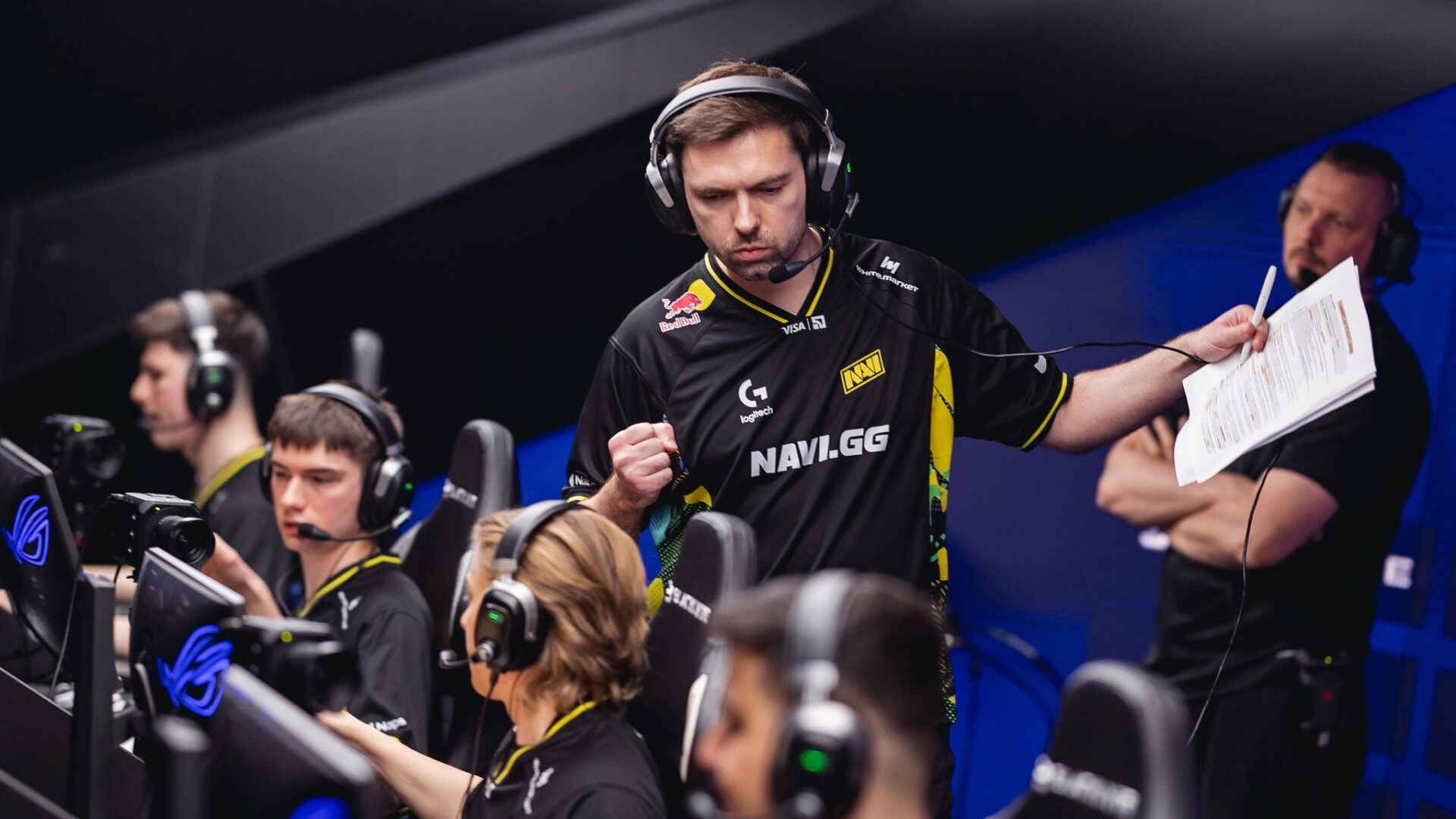
In Counter-Strike, it is increasingly rare for the team that simply shoots better to win. At the top level, the difference is more and more often made not only by tactics, but also by how a club works with a player’s mind, habits, emotions, and personal traits. That is exactly what B1ad3 spoke about when he directly called performance coaching the future of professional CS.
A coach in CS can no longer carry everything alone
According to B1ad3, the modern team structure can no longer be built around one figure who is responsible for literally everything. He states this point directly:
Usually, organizations give full responsibility to the coach… But I always try to delegate things to different people.
This is an important idea because it clearly shows how the image of the coach in esports is changing. In the past, a coach was imagined as a person who had to simultaneously be a strategist, psychologist, manager, and crisis dispatcher. But at the modern level, that model already looks outdated. If a team wants to be stable, it has to divide responsibility among specialists.
Mental work is no longer an “extra” — it is becoming part of the system
The most interesting part of B1ad3’s words is his emphasis on the mental aspect. He says directly that he delegates much of this work to a performance coach, and it does not sound like a fashionable bonus or a nice detail for a presentation. It sounds like a full-fledged part of the daily preparation system.
In this logic, a performance coach is no longer “the person who helps when everything is going badly,” but a specialist who allows a player to make better use of himself. And here B1ad3 moves on to another strong idea: every player has their own traits, and the task of the club is not to suppress them, but to understand them and direct them in the right way.
B1ad3 is effectively talking about a new language of working with players
This is especially clear in the moment where he mentions ZywOo, s1mple, and the individual differences of every player. The message here is very modern: great talent does not exist in a vacuum. It comes with its own traits, its own patterns, its own strengths and weaknesses. And instead of “breaking” a person to fit one model, you need to understand how exactly that personality works at its maximum.
That is exactly why this line sounds so important:
We just need to understand what it is and how to work with it. You need to direct that energy toward the goal.
In effect, B1ad3 is describing a shift from the old coaching approach of “adapt yourself to the system” to a new one — “the system must know how to work correctly with the type of player.” For modern CS, that is a very strong turn.
Why this really does look like the future
Looking at the bigger picture, there is very sober logic in B1ad3’s words. At the top level, almost all teams already have firepower, demos, analytics, veto preparation, and a standard support staff. But far from all of them work equally well with pressure, confidence crises, ego, communication, or mental exhaustion.
And that is exactly where performance coaching can provide an advantage that cannot be copied quickly.
- one player handles the pressure of a decisive match better;
- another gets out of a losing stretch more quickly;
- a third finally begins using his strengths instead of fixating on his weaknesses.
This is not as loud an advantage as a new superstar signing. But over time, it can be just as valuable.
This is not just a nice theory, but the direction the whole scene will move toward
What makes B1ad3’s words interesting is that they describe not abstract psychology, but a very practical evolution of Counter-Strike. A coach no longer has to be the person responsible for everything. A great roster can no longer rely only on firepower, tactics, and discipline. And the player of the future is not just someone who is mechanically strong, but a person who understands how their own mind works.
That is why B1ad3’s thesis that performance coaching is the future of CS does not sound like a nice phrase for an interview. It sounds like an honest description of where the scene is actually heading.