

Another FACEIT ban could have remained a local story about toxicity in matchmaking, but this time it quickly went in a different direction. After an attempt to present the punishment as unfair, screenshots and statements surfaced publicly that turned a routine moderation dispute into a far more toxic and politically charged conflict.
How it started: a ban presented as absurd
Initially, the story revolved around a post by player Grey, who complained about a FACEIT punishment and tried to portray it as almost absurd. One of the screenshots shows a cooldown notification for verbal abuse. The platform itself clearly explains that such bans are issued by the automated Minerva system, which detects abusive language and toxic behavior; initially, a user may receive a warning, but repeated violations lead to a 24-hour ban and further escalating sanctions.
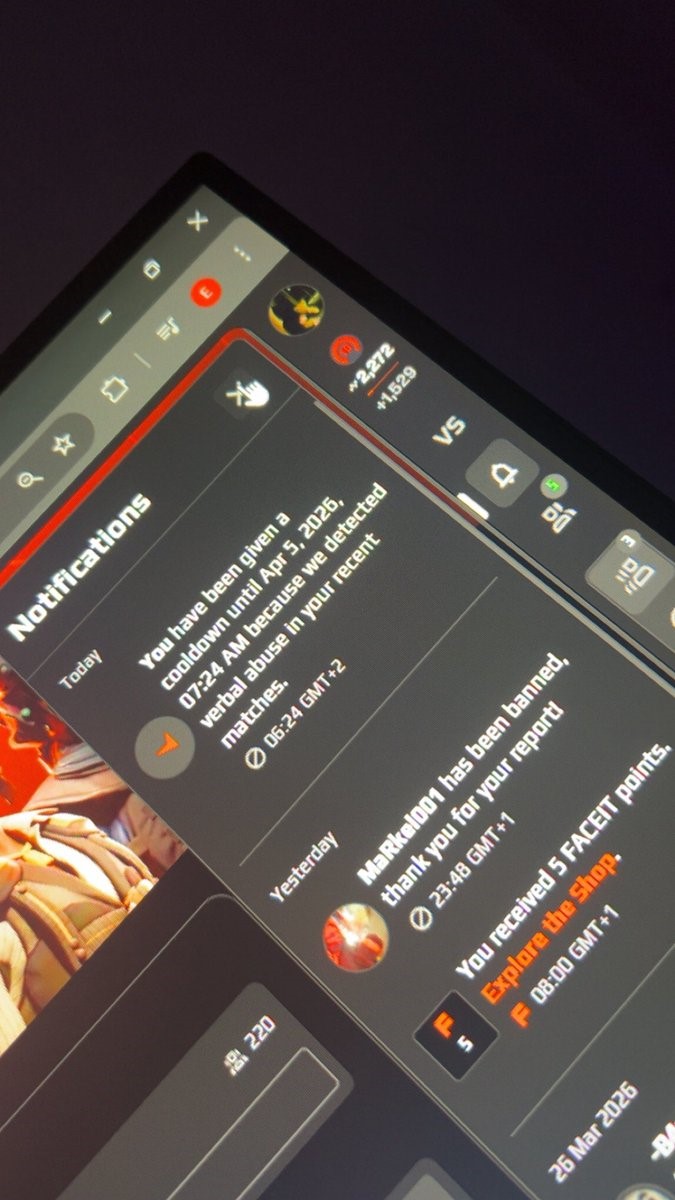
In this sense, the beginning of the conflict was quite typical for the FACEIT scene: a player attempting to frame the punishment as exaggerated or a system error. However, the situation shifted when what entered the public space was no longer just complaints about moderation, but much harsher statements that changed the entire context of the discussion.
What broke the defense narrative
In widely shared screenshots from X, a response from the FACEIT Darwin account appeared, stating directly that the ban was not due to an innocent remark, but because of statements directed at Ukrainians and Russians during a match. After this, the narrative of “I was punished for nothing” began to collapse.
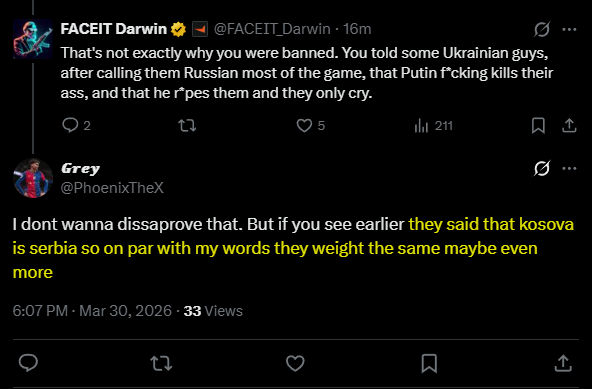
Analytically, this is the key moment. In such cases, everything depends on which version of the conflict the audience accepts first: either it is another case of flawed automated moderation, or it is a situation where a player downplays their own behavior. Here, the situation clearly shifted toward the latter, as public attention moved from “was the ban fair?” to “what exactly was said during the match?”.
Why this situation went beyond a typical toxicity scandal
The conflict escalated further when the discussion expanded beyond complaints about FACEIT to include political and ethnic statements. In some screenshots, the player appears to justify their language with additional offensive claims, pushing the discussion into the realm of national and political disputes.
At that point, the story stopped being just about poor in-game communication. When a player responds to a ban not by de-escalating, but by continuing to speak publicly in a similar tone, it almost automatically strengthens the moderation’s position. The issue no longer looks like a one-time lapse during a match, but rather like a consistent pattern of behavior.
The key takeaways here are:
- the ban no longer appears as a случайное misunderstanding;
- the public reaction worsened the player’s reputational position;
- the conflict with FACEIT turned into a broader discussion about acceptable behavior within the community.
What this situation says about FACEIT and its punishment system
This case is also illustrative of a broader topic — how moderation works on FACEIT today. The platform has long promoted the idea that Minerva punishes toxic language in context, not just isolated “bad words.” FACEIT’s documentation states that the system analyzes the overall tone of messages, with a relatively high threshold for penalties.
This does not mean automated bans cannot be controversial. But in cases like this, where even more toxic rhetoric emerges after the sanction, the platform hardly needs to defend itself. The player effectively reinforces the argument that the ban was not accidental, but a logical consequence of their behavior.
This is no longer a story about an “unfair ban”
The controversy around Grey’s FACEIT ban quickly lost the appearance of a questionable moderation case. After public statements and follow-up posts, the conflict is now perceived very differently: as a situation where an attempt to present oneself as a victim of moderation only revealed a deeper layer of toxicity.
In the end, this is more damaging to the player than to FACEIT. When a public defense is built not on refutation, but on further aggressive statements, the outcome becomes almost inevitable: the ban stops looking debatable and starts looking predictable.